What's the difference?
Station wagons might have fallen out of favour in Australia over the past 10 years or so, with their market share gobbled up by SUVs, but if anything can lure buyers back it will be vehicles like the Audi RS4 Avant.
The speed of a genuine performance car, the space of a family wagon, and, in our opinion, stunning looks. What more could you want?
The question, though, is does this updated-for-2021 version still deliver on its dual promises of practicality and performance? Let's find out.
After teasing us with the S3, all-wheel-drive version of its A3 sedan and hatch (Sportback in Audi-speak), Audi has finally given us the full-fat, RS3 variant of the same car. Any time you see an `R’ and an `S’ on the badge of an Audi, you know it’s the full nine yards in terms of all-wheel-drive grip and engine performance. And the RS3 is no different.
The power is enormous, the grip prodigious and the attitude is way tougher than any other A3 variant. It’s also well equipped, safe and nicely put together. But is that extra `R’ worth the added price of admission? And is this more Audi A-Series than you really need?
The other question is, given that the S3 is such a resolved package with its own shot of high-performance, do the numbers stack up for the RS3 version? How much is too much?
Practicality, performance and polish, all in one very handsome wagon shape. The Audi RS4 Avant is welcome reminder of the days before SUVs ruled the world, and it leaves you wondering how we ever allowed that take-over to happen at all.
If conventionally powered cars really are on the endangered list, it’s vehicles like the Audi RS3 that will remind us what we’ve lost. There’s so much fun to be had in this car, that you really need to take it to a track to tap into it safely and responsibly. And there’s the rub.
While there’s no doubting the RS3’s potential, neither is there any doubt that the driveline absolutely dominates the experience. In fact, we reckon the S3 with its more modest (but still ample) performance and friendlier nature is probably the smarter car for the everyday. It’s also cheaper by about $20,000 and while it lacks the aggressive looks, it’s still a charming car. Perhaps all the more charming for its easier-going nature and balance of abilities.
So why buy the RS3? Because it’s the one that will keep you entertained for longer if you’re a serious enthusiast driver. But if you don’t plan to use the car for track days, there’s a strong argument that the RS3 is way more car than you’ll ever need. Of course, that sentiment never stopped performance-car lovers, did it?
I think it looks fantastic; a tough, low-slung performance wagon that makes you long for the days when SUVs were only for people who wanted to climb mountains, not driveways.
Looking at it straight-on, the Audi RS4 Avant looks wide and mean, with its blacked-out mesh grille that's kind of folded in the middle, giving it a sharp ridge that juts out in front of it. Interestingly, Audi's Single Frame Grille treatment is now a kind of no-frame grille, with the body colour extending all the way to beginning of the meshing.
Those 20-inch alloys perfectly fill the swollen wheel arches, with the red of the massive brake calipers peeking out from behind the spokes, while at the rear, two massive exhaust exits frame the rear end.
Inside, it's a blacked-out, leather-wrapped space that feels both tech-savvy and well constructed. There's ridged leather on the seats, and a satisfying chunkiness to both the flat-bottomed steering wheel and the sizeable gear shifter.
I've heard people complain about the positioning of the 10.1-inch centre screen, perched as it is above the dash a little like an afterthought, but I really don't mind it. Its big, clear, and positioned where it is, easy to both read and reach.
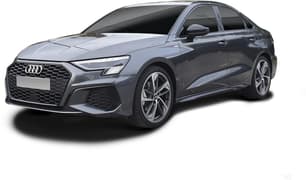
While the overall shape of the RS3 suggests evolution rather than revolution, the RS3 treatment has led to a much sportier look. We still reckon the sedan is the pick of the two body styles, mainly because it looks a bit more aggressive. Certainly, though, an aggressive look is not something either version backs away from, and those deep, wide blacked-out honeycomb grilles front and rear give the thing lots of presence.
So too do the blistered fenders, allowing for the extra track width that gives the RS3 its unique footprint. The front track itself is 30mm wider, but the wider fenders also gave Audi the chance to do some creative aero-management. Unlike, say, the Toyota Supra, for instance, with its faux vents up each side, the RS3’s lower-front vents and aero-slits behind each front fender are fully functional, directing air into the engine bay and away from the brakes respectively.
Another really neat function is the LED daytime running lights’ one-act play when you unlock the doors. As the car unlocks its doors, the LEDs spell out `R’, `S’ and `3’in sequence. Blink and you’ll miss it, but it’s a lovely touch that some manufacturers will never understand.
Ah, the practicality of a wagon, remember that? Honestly, I'm sometimes surprised that SUVs have managed such a hostile takeover, especially when I climb out of a well-sorted estate, like the RS4 Avant.
It measures 4782mm in length, 1866mm in width, and 1438mm in height, making it slightly longer - but much lower - than the Audi Q5.
But while Audi's SUV manages a commendable 463L of luggage space with the rear seats in place, the RS4 Avant delivers 495L, with the that number swelling to 1495L with the second row folded flat.
The point is, it delivers the perks of a sizeable SUV, without ever feeling so big.
Up front, riders will share cupholders, bottle holders in the doors, and multiple USB and power connection point, along with storage cubbies of various sizes and shapes.
In the back, rear seat riders get the same premium interior treatment as the driver, and get their own air vents with digital climate controls, bottle holders in their doors, USB connection points, and ISOFIX attachment points at each of the window seats in the back.
Like the rest of the Audi A-series range, the RS3 is available in two body styles, a five-door hatchback and a four-door sedan. The five-door hatchback layout is the most practical of the two RS3 layouts, but both feature plenty of front-seat space and a rear seat that folds 40:20:40.
Paddle shifters are mounted on the steering wheel rather than the column, so they move with the wheel. That can make it difficult to select the correct paddle in a hurry with lots of lock applied.
The Drive modes are operated by a switch low down on the centre-stack that is clearly designed for left-hand-drive cars. It’s too far from the driver and needs to be cycled through in one direction, rather than being able to select the next mode or the previous one.
Beyond that, the interior is a lesson to other car-makers on how to get an interior right. There’s a quality look and feel with the possible exception of the plastic trim below the passenger-side air-vents which looks and feels a bit cheap. There are plenty of cup-holders and cubbies around the cabin with two USB plugs in the front and two in the rear (for charging).
The RS3 loses some space compared to the regular A3 because of the performance hardware. Where the hatch can take 282 litres with all seats in place (1104L with second row stowed), the sedan can swallow 321 litres.
Right, so it isn't particularly cheap, the RS4 Avant, which arrives wearing a $147,900 price tag before you start ticking option boxes. Our test vehicle, for example, had gloss-black alloys, carbon inserts and a blacked-out version of Audi's rings and badges, which lifted the asking price to $150,400.
That's if you want to trouble the option list, of course, because actually, the RS4 Avant arrives with just about everything you could need.
Outside, you'll find 20-inch alloys, red brake calipers, heated mirrors, privacy glass and a sunroof, while inside you'll find Nappa leather seats that are heated in the front, ambient interior lighting, and a Bang and Olufsen sound system.
Tech is now handled by a bigger 10.1-inch touchscreen that gets Apple CarPlay and Android Auto, and there's wireless charging for your smartphone, too. You also get standard navigation, as well as Audi's Virtual Cockpit - which replaces the dials in the driver's binnacle with a digital screen - that's been updated with new RS functionality.
What you’re buying here is not a car in a different size or luxury category compared with its S3 and A3 stablemates, but a car with a much broader performance envelope. So it’s no surprise to learn that a lot of the extra money goes into that type of hardware.
So rather than the class-standard four-cylinder engine, the RS3 gets a five-cylinder engine measuring 2.5 litres and enough performance to challenge many a supercar of just a handful of years ago. That philosophy also requires bigger brakes, firmer suspension and a more complex, track-oriented version of the electronic rear differential that can turn the car into a drifter or a race-track hero. Wheels and tyres are competition-spec, too.
In turn, those changes have forced other alterations such as the wider fenders and more intricate body kit, the former to physically fit the tyres, the latter to control air-flow for high-speed stability and for thermal management.
Other RS3 additions to what was an already well-equipped car in the S3, include lots of Audi’s trademark honeycomb styling panels around the car, RS3 puddle lighting, LED headlights and daytime running lights, carbon and aluminium interior inlays, RS sports seats with four-way lumbar support and a massage function.
There are two USB ports, wireless phone charging, another pair of USB ports in the rear, Bang and Olufsen stereo, head-up display, tinted glass, heated, folding exterior mirrors and Nappa leather throughout the interior. There’s also Android Auto, a wireless version of Apple CarPlay and digital radio.
The RS3 uses Audi’s celebrated virtual cockpit display with a choice of display layouts for the driver as well as a 10.1-inch touchscreen to control all the connectivity and infotainment settings. It uses the latest version of Audi’s MMI interface.
Like the other A3-based Audis, there’s a price premium for the sedan body over the hatchback, making the five-door RS3 a $91,391 purchase against the sedan at $93,891. Compared with the S3 CarsGuide tested earlier this year, that represents a pretty big jump from that car’s $70,700 (hatch) and $73,200 (sedan). That said, there’s a fair bit more going on in the RS3 in every department, but you get the sense that this comparison will be one nearly every potential buyer will make.
Like most Audis, there’s a range of optional packages, starting in the RS3’s case with the Carbon Package which brings carbon-matte inlays to the interior, side skirts, exterior mirrors and a carbon roof spoiler for the Sportback and a carbon roof-lip spoiler for the sedan. That costs $7400 on the hatch and $6300 on the sedan.
The Matte Aluminium Package is next with a few trim pieces finished in an aluminium material for $2000 extra and there’s also a panoramic sunroof on offer for $2600.
The RS Design Package gets you an Alcantara-covered steering wheel, seat belts in green or red as well as coloured elements to the seat shoulders, floor mats and the air-vent highlights. Yours for $2150.
The most serious option is the RS Dynamic Package which brings carbon-ceramic brakes with a choice of caliper colour as well as an electronic reflash to bring the top speed of the RS3 to 290km/h from its standard (limited) 250km/h. That adds another $13,000 to the price.
One thing that’s nice to see is that Audi has made even the pearl and metallic colours a no-cost option on the RS3. Other manufacturers should take note.
It's a beast of a power plant - a twin-turbo 2.9-litre six-cylinder TFSI that will deliver 331kW at 5700rpm and 600Nm at 1900rpm, sending it thundering to all four wheels (because quattro) via an eight-speed tiptronic automatic.
That's enough, says Audi, to deliver a 0-100km/h sprint time of 4.1 seconds, which is plenty quick.
While the five-cylinder engine is more or less a carry-over from the previous RS3 model, the end result is still a pretty stunning one. With 2.5 litres of capacity, the turbocharged unit accounts for 294kW of power (the same as the previous model) and 500Nm of torque (up 20Nm).
The transmission is a seven-speed dual-clutch unit that is quite a familiar sight around Audi by now, and the all-wheel-drive system uses a centre differential with an electronic clutch-pack on each rear axle to give the car a Drift mode (although Audi insists you don’t refer to it in those terms) as well as torque vectoring with the ability to shift 100 per cent of rear-axle torque to the either wheel to maximise grip.
There’s now also an RS-specific exhaust system with an active flap to increase or tame exhaust noise according to which drive model is selected. The drive modes themselves stretch form Comfort to Auto to Dynamic, altering shift points, gear-shift aggression, throttle response and suspension firmness as well as that exhaust flap.
Brakes are enormous 375mm front rotors with six-piston calipers, that hardware forcing the fitment of a 19-inch alloy wheel (specific to the RS3) for brake clearance.
Audi says you'll get 9.5L/100km on the combined cycle, and emit 218g/km of CO2. But not if you drive it like you'll want to drive it. Get a little too familiar with the accelerator and you can expect that number to climb.
The RS4 Avant is fitted with a 58-litre fuel tank.
Audi’s official combined fuel consumption figure for this car is 8.3 litres per 100km. Obviously, start using all that power and torque and that figure will grow significantly. Based on that, the car emits 190 grams of CO2 per kilometre, and with the 55-litre tank (which looks a bit small on paper) the range should still be around 600km between fill-ups.
The only catch with that is the high-tech nature of the engine means it requires the more expensive, Premium ULP at the bowser.
It's a thundercat, the RS4 Avant, and might well be among the world's most undercover sleepers, given its ability to deliver near-supercar pace from its fairly understated station wagon body shape.
Sink into the driver's seat, grip the chunky, leather-wrapped steering wheel and kick over the engine, and the low rumble of then exhaust immediately informs you that you're in something with some serious performance potential.
The acceleration is properly addictive, with the RS4 piling on speed on the exit of corners, shrinking the gap between bends so much that you're hurriedly standing on the brakes again as you barrel into the next turn before you know it.
It feels properly, properly sporty, and you can't help but feel a little smug about the fact you can effectively pour an entire Bunnings into the massive boot, where people in true supercars are lucky if they can fit even fit themselves in them.
And I think that's the magic of a car like this, that straddles that line between practical and potent with such aplomb, it feels like it you're not making much in the way of sacrifices, and you can knock off the school run or a hill sprint with equal ability.
Downsides? Well, even in its angriest settings, the gearbox felt a little fidgety at pace, shifting up or down at strange moments on the way into or out of corners. You can take control via the paddle shifters, of course, but it wasn't the most intuitive gearbox I've experienced. The steering, too, felt a little - and I mean a little - disconnected, even in its sportiest settings.
First impressions are that this is a typical Audi in the way it fits together beautifully and is made from quality materials. The ergonomics – particularly the virtual cockpit - are spot on and it even smells like an Audi. Noise is well suppressed, the controls feel quality and the front seats are comfy. But from there, the overarching view is dominated by that powerhouse of an engine.
This isn’t just a quick car, it’s actually brutal in the way it builds boost almost immediately and then hurls the car down the road. To be honest, it’s almost too much, and the way the RS3 reels in the horizon will leave some drivers ignoring other sensory inputs in order to keep up with the car. Brutality breeds brutality, too, and the subsequent steering and braking inputs required when the throttle is pinned will not always be the considered, gentle type; they’ll often be gut reactions.
Thankfully, the rest of the driveline and platform has the smarts to make all this work. There’s awesome grip from the Quattro all-wheel-drive system and the car stays flat and steers in a fast, neutral but pin-sharp way. The dual-clutch transmission feels perfect for the engine, too, with ultra-quick shifts that become more aggressive as you ramp up the drive modes. Ride quality is good but we reckon there’s less bandwidth in the various drive mode settings than exists in the same system fitted to the S3 model we drove a few months ago. While the latter offered a broad range of suspension firmness, the RS3 seems to be a bit of a prisoner of its own performance, with Audi leaning all the drive modes towards a firmer setting in the name of body control.
That’s supported by Audi’s decision to offer us some race-tack laps in the RS3 to safely explore its high-end tendencies. At this point, the car emerges as a proper track-day proposition, all that power and control blending into a car that loves being thrown around a circuit. Perhaps the front seats could do with a little more side bolstering at track-cornering speeds, but overall, it’s clear that the RS3’s brief does, indeed, include a degree of race-track use.
The safety story begins with eight airbags, and the usual suite of braking and traction aids, but then climbs into the tech-savvy stuff from there.
You get a 360-degree camera, adaptive cruise with stop and go, active lane assist, front and rear parking sensors, AEB with pedestrian detection, rear cross-traffic alert, an exit warning system, blind-spot monitoring and turn assist, which monitors oncoming traffic when making a turn.
It's a lot of gear, and it all contributes to Audi's five-star ANCAP safety rating, awarded in 2015 to the A4 range.
The RS3 hasn’t been crash-tested locally, but the A3 on which it is substantially based has been and scored five stars back in 2020. The caveat there is that that result related to the lighter front-wheel-drive version of the car, not the RS3’s all-wheel-drive variant.
The RS3 is well equipped from a safety perspective with seven air-bags including a head-level curtain airbag that protects occupants in both the front and rear seats. There’s also Audi’s Pre-Safe which closes the windows and sunroof and pre-tensions the seat-belts if the car thinks a shunt is imminent. In the RS3’s case, that program has been extended to include autonomous emergency braking which works at speeds up to 250km/h and can identify pedestrians and cyclists up to 85km/h.
There’s also a tyre-pressure monitoring system, lane-change warning, rear cross-traffic warning, lane departure warning with active intervention of the steering, parking cameras front and rear, park-assist, and a 360-degree camera system with various points of view.
Audi vehicles are covered by a three-year, unlimited-kilometre warranty, which is feeling more than a little underdone when compared to some competitors.
Services are due every 12 months or 15,000kms, and Audi allows you to pre-pay your service costs for the first five years, at a cost of $3,050.
Service intervals for the RS3 are every 12 months or 15,000km, whichever comes first. Audi offers capped-price servicing for the RS3 at $3580 which covers servicing costs for the first five years.
The car is covered by Audi’s five-year/unlimited kilometre warranty. The vehicle is also protected against body-rust perforation for 12 years.