What's the difference?
Since 1949, Abarth has been giving the venerable Italian brand, Fiat, a patina of performance, based largely on giant-killing feats in small modified cars like the Fiat 600 of the 1960s.
More recently, the brand has been revived to boost the fortunes of the smallest Fiat on sale in Australia. Known formally as the Abarth 595, the tiny hatch packs a bit of a surprise under its distinctive snout.
Replacing the long-standing UX250h, the more powerful Lexus UX300h hybrid sits at the luxury end of the compact SUV segment, and the latest update brings a refined line-up along with tweaks to both design and technology. In this review, I’m looking at the base Luxury grade to see what it's like to live with this hybrid day-today and how it stacks up against its nearest rivals.
It’s tough to be kind to the Abarth 595. Based on a platform that’s more than a decade old, the car has been left behind by its rivals in many ways, including basic ergonomics and its value equation.
The larger engine does work well in this smaller package, and its road-holding ability belies its size. However, only die-hard fans of the Abarth brand will be able to cope with the uncomfortable seating position and a complete lack of even the most perfunctory features that cars costing $10,000 less are able to offer.
The updated Lexus UX300h Luxury is a solid entry in the premium compact SUV segment. It doesn’t break new ground, and there are areas that could be improved, but it handles well, offers a thoughtful selection of amenities for a base-grade luxury model, and its compact size makes it easy to park almost anywhere. For buyers seeking a stylish, efficient, and practical hybrid with a luxury badge, it’s a dependable choice.
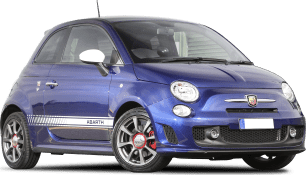
Despite being based on a design that’s a decade old, the Abarths still stand out. Based on the classic Fiat 500 shape of the 1950 and '60s, it’s more cute than cut-throat, with a narrow track and tall roof giving it a toy-like presence.
The Abarth attempts to beef things up with deep front and rear bumper splitters, go-fast stripes, new headlights and alternate-colour wing mirrors.
The 595 rides on 16-inch rims, while the Competizione runs 17s.
Inside, it’s definitely different to most mainstream cars, with colour-coded plastic panels on the dash and a very upright seating position, along with a dual-tone steering wheel.
It’s a love-it-or-hate-it proposition. There’s no middle ground here.
The updated Lexus UX is technically a compact SUV, but it feels more like a hatchback that's taken a small dose of steroids. The facelift brings a sharper look with a stylised 3D spindle grille, new air intake vents, fresh 17-inch alloy wheels, updated daytime running lights and a full-width rear light bar. The sculpted bodywork still showcases Lexus’ signature origami-like panelling and, overall, it’s a handsome little thing. That said, the heavy use of black plastic moulding around the lower edges detracts from its premium appeal.
Inside, the cabin takes a more understated approach. Up front it feels premium-enough, with synthetic leather trims, soft-touchpoints and those high-tech dual 12.3-inch displays headlining the dash. Your eye moves smoothly across the layout without lingering too long on any single element, which adds to the sense of elegance.
Not everything feels top-tier, though. Hard plastics are still scattered throughout the cabin, and they’re especially noticeable in the back seat where the doors have very little in the way of a soft surface. Yes, this is the base grade, but in a car wearing a luxury badge, it’s something you notice more than you should.
This is another area where the Abarth falls down. First and foremost, the seating position for the driver in both cars is utterly compromised.
The seat itself is mounted far, far, too high, and has little adjustment in any direction, and there is no reach adjustment in the steering wheel column to allow a taller (or even an average height) driver to get comfortable.
The more expensive Competizione we tested was fitted with a set of optional sports bucket seats from racing company Sabelt, but even they are mounted literally 10cm too high. They are also ultra firm, and even though they look supportive, lack decent side bolster support.
The tiny multimedia screen is okay to use, but the buttons are miniscule, while there’s a complete lack of storage places in the front.
There are two cupholders under the centre console, with two more in between the front seats for rear seat passengers. There are no bottle holders in the doors and no storage for rear seaters.
Speaking of the rear seats, they are the very definition of cramped, with little headroom for moderately sized adults and precious little knee or toe room. There are two sets of ISOFIX baby seat mounting points, though, should you fancy wrestling your wriggling toddlers through the narrow aperture.
The seats flip forward to reveal more cargo space (185 litres with the seats up, and 550 litres when the seats are down), but the seat backs don’t fold flat into the floor. Under the boot floor is a can of sealant and a pump, but no space saver spare.
In truth, it was a long day testing this car… at 187cm, I simply could not get comfortable in it at all.
The UX is a compact SUV, so it's best not to expect a sprawling interior. The front row offers the best space and comfort, with wide door openings and a ground clearance that makes it easy to hop in without any grunts. The seats are comfortable enough on long drives, although some fatigue creeps in on the passenger side due to the lack of lumbar support. Both front seats are power-adjustable and heated, and with the steering wheel also adjusting electrically, it’s easy to dial in a good driving position.
Move to the rear seats, and space becomes noticeably tighter for adults. At 168cm, my knees press against the seat in front, and even my eight-year-old asked me to slide the passenger seat forward this week. That said, he’s been mostly comfortable thanks to the wide door openings, lightweight doors and well-padded seats.
My son did point out that the tall window sills make it hard to see out, which could be a deal breaker for younger passengers. There are three top tether anchor points, but fitting three child seats across is unrealistic.
Storage is on the slim side, but the dual-opening centre console is clever, and there are two cupholders and drink bottle holders up front. The rear row only gets a single map pocket and two cupholders. A few more cubbies for things like sunglasses or keys would be welcome, as the cabin can quickly feel cluttered if you’re not careful.
Technology is neatly integrated. The dual 12.3-inch displays look sharp with clear graphics, and the touchscreen is responsive. The updated operating system isn’t a big leap forward, but it’s easy to use and the wireless Apple CarPlay and Android Auto work seamlessly. There’s also sat nav, a wireless charging pad, four USB-C ports, a single USB-A port and a 12-volt socket for charging.
The boot looks modest at first glance, especially with the floor set in its highest position, but it still swallowed a big grocery shop with no fuss. Officially, capacity is 364 litres, which makes it the smallest compared to its nearest rivals, although the adjustable floor helps with taller items or creates a handy nook for smaller ones.
A bigger drawback is the lack of a spare tyre as you only get a repair kit. For city drivers that might be fine, but for those of us who live regionally or do longer trips, a spare tyre is a must-have. On the plus side, the powered tailgate with kick function is standard here, whereas rivals make you pay extra for it.
The range has been stripped back to just two cars, and costs has come down slightly, with the 595 now starting at $26,990, plus on-road costs.
A new 5.0-inch touchscreen multimedia system (with digital radio), a leather wrapped steering wheel, TFT dash display, rear parking sensors, alloy pedals, 16-inch alloy rims, and (front-only) adaptive dampers are standard on the base 595.
A convertible, or more accurately, a rag-top (cabriolet) version of the 595 is also available for $29,990.
The 595 Competizione is now a whopping $8010 cheaper at $31,990 with a manual gearbox, leather seats (Sabelt-branded sports buckets are optional), 17-inch alloys, a louder Monza exhaust, as well as front and rear adaptive Koni shocks, and Eibach springs.
Unfortunately, what stands out more on the Abarths is what they don’t come with. Auto lights and wipers, cruise control of any sort, driver aids including AEB and adaptive cruise… even a rear view camera is missing.
What’s more puzzling is that the Abarth’s architecture, though a decade old, has provision to accept at least a rear view camera.
Abarth’s explanation that the car’s home market doesn’t see these inclusions as important doesn’t really hold water, either.
In terms of value, the lack of basic content sends the Abarth to the bottom of a competitive pile that includes both the Ford Fiesta ST and the Volkswagen Polo GTI.
The new Lexus UX300h is offered in three grades, and the grade tested here is the entry-level Luxury, priced from $55,370 before on-road costs. That positions it right in the middle of its rivals, with the Audi Q2 35TFSI S starting at $49,400 and the Volvo XC40 kicking off from $56,990.
The Luxury grade brings a solid list of standard equipment. While it won’t blow your socks off, it does offer good value-for-money compared to its premium competitors where a lot of features have to be added for additional cost. Highlights include powered front seats with heat function, synthetic ‘NuLux’ leather upholstery and trims, dual 12.3-inch displays and a upgraded OS for the multimedia system. You’ll also find a 10-speaker sound system and seamless wireless phone mirroring for both Apple CarPlay and Android Auto.
Technology extends further with built-in satellite navigation, Bluetooth, digital radio, reversing camera, two USB-C ports in each row, plus a USB-A port, 12-volt socket and wireless charging pad up front.
Practical features like keyless entry and start, dual-zone climate control, dusk-sensing headlights, updated daytime running lights, rain-sensing wipers, electrically adjustable steering wheel and a powered tailgate with kick function.
A three-year complimentary membership to the Lexus Encore program rounds out the package. Members gain access to the Lexus Connected Services phone app where you can customise your driver profile and have access to a digital key but there are a range of benefits from supporting partners like Westfield and Ampol to enjoy as well.
The Abarth 595 pair use the same 1.4-litre 'MultiJet' four-cylinder turbo engine in differing states of tune. The base car makes 107kW/206Nm, while the Competizione makes 132kW/250Nm, thanks to a freer-flowing exhaust, a larger Garrett-branded turbocharger and an ECU re-tune.
The base car can do 0-100km/h in 7.8 seconds, while the Competizione is 1.2 seconds quicker; the optional 'Dualogic' automatic is 0.2sec slower to the mark in both cars.
A five-speed manual gearbox is standard, and neither car is fitted with a limited slip diff.
The UX300h Luxury runs a hybrid setup that pairs a 2.0-litre four-cylinder petrol engine with two small electric motors. Combined, the system produces 146kW of power, and it drives through an electronic continuously variable transmission (eCVT). This powertrain sees it outmuscle the old UX250h by 15kW.
On paper, those new outputs sit neatly in the middle of this segment. Out on the road, though, the hybrid assistance helps the UX feel a little more sprightly than the numbers suggest. The electric motors give it an eager step-off from traffic lights and smooth power delivery around town, while the petrol engine takes over when more effort is needed.
It's a good combination for a little car.
Over 150km of testing, the Competizione consumed a dash-indicated 8.7 litres per 100km, against a claimed combined fuel economy figure of 6.0L/100km. Our brief test of the 595 revealed a similar number, against the same claimed figure.
The Abarth will only accept 95 octane fuel or better, and its small 35-litre tank is good for a theoretical 583km between fills.
Fuel efficiency is a real strength. Lexus claims 4.2L/100km on the combined cycle, which is impressive against petrol-only competitors. With a 43L tank, you’re looking at a theoretical driving range of over 1000km between fills.
In my week of mixed open-road and urban driving, I saw a real-world figure of 5.0L/100km, and that’s without holding back on using the available power, which makes the claim feel very achievable.
Ergonomics aside, the combination of torquey engine and lightweight car is always a good one, and the 1.4-litre turbocharged four is a good match with the front-drive Abarth.
There’s always enough mid-range urge to give the Abarth the hurry-up, and the longer-legged five-speed gearbox is a good match for the engine.
It also grips and turns surprisingly well, despite the Sport button adding too much artificial weight to the Abarth’s steering feel.
That same button also firms up the front dampers on the 595 and all four on the Competizione, which works well on smoother terrain, but stiffens it too much over more undulating surfaces.
Around town it can be hard to strike a good balance between ride and comfort. The difference between soft and firm is much more pronounced in the Competizione, but it will still get tiring if your commute is a bumpy one.
The turning circle, by the by, is ridiculously large for such a small car, making u-turns - already compromised by the lower front bumper - unnecessarily fraught.
The Monza exhaust on the Competizione gives it a bit more presence, but it could easily be louder (or at least more crackly) again; you’re not buying this car to be a wallflower, after all.
The UX300h Luxury proves itself to be a versatile little SUV. It offers ample power with prompt acceleration, making it easy to confidently take a gap in traffic or keep pace on the open road. It feels like a solid all-rounder that balances everyday usability with just enough grunt when you need it.
There are three selectable drive modes, though in practice they don’t feel dramatically different. The hybrid system can sometimes sound a little flustered at times as it switches between the two components, but it doesn’t translate into anything unsettling from behind the wheel. The actual driving experience remains smooth and predictable.
Ride comfort is another strength. The suspension does a good job of soaking up small bumps, and unless you’re on the highway in torrential rain, the cabin stays impressively quiet.
Visibility is mostly good, although the A- and B-pillars can occasionally intrude from the driver’s seat. It’s never enough to be a deal breaker, but worth noting. Where the UX really shines is in tight spaces because its 10.4m turning circle and compact dimensions makes it stupidly easy to park. The reversing camera is clear, though for a car wearing a luxury badge, it feels like a missed opportunity not to include a 360-degree camera as standard.
Despite a lack of electronic safety aids – and, somewhat amazingly in the current age, a rear-view camera – the Fiat 500 that forms the Abarth's basis still carries the maximum five-star rating from ANCAP it was awarded in 2008, by dint of its seven airbags and bodyshell strength.
It wouldn’t have the same luck if it were judged under new ANCAP regs coming into force in 2018, though.
The UX300h Luxury comes equipped with Lexus Safety System+, covering the essentials and more. Standard features include lane keeping aid, lane departure alert, adaptive cruise control, traffic sign recognition, blind-spot monitoring, front collision warning, rear cross-traffic alert, rear seat alert, safe exit assist, ISOFIX child seat mounts, three top tether anchor points and tyre pressure monitoring.
Dusk-sensing headlights, rain-sensing wipers, and the restyled LED daytime running lights further improve visibility and overall safety.
The UX has a maximum five-star ANCAP safety rating from testing conducted in 2019, scoring highly across all individual assessments. While the updated model hasn’t yet been re-tested under the latest criteria, its suite of standard safety technologies and solid crash history should offer some reassurance.
The UX has autonomous emergency braking (AEB) with pedestrian and cyclist detection and is operational from 10 - 180km/h but it is normal to see this begin from 5.0km/h on competitors.
A three-year/150,000km warranty is offered as standard on the Abarth 595 range, with a suggested service interval of 12 months or 15,000km.
Abarth importer Fiat Chrysler Automobiles Australia offers three fixed-priced services for the 595 range at 15,000, 30,000 and 45,000km, with the first costing $275.06, the second $721.03 and the third $275.06.
The UX300h Luxury comes with a five-year/unlimited kilometre warranty, which is comparable to its nearest rivals, although we’re seeing increasingly generous terms from mainstream brands.
Servicing is straightforward thanks to a five-year capped-price program, with each service costing $595. The intervals are well spaced at every 12 months or 15,000km, whichever comes first.
This grade also includes a three-year complimentary membership to the Lexus Encore program. Membership brings access to the Lexus Connected Services phone app, allowing you to customise your driver profile and even use a digital key. Beyond that, Encore members enjoy perks with supporting partners, including Westfield and Ampol.
There's around 40 official Lexus service centres located around Australia but you can make use of its sister brand's (Toyota) service centres if you're in a pinch.