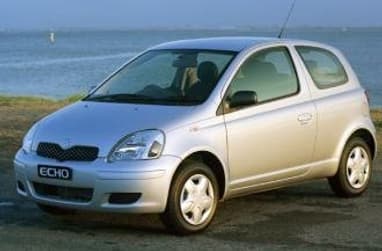
Are you having problems with your 2005 Toyota Echo? Let our team of motoring experts keep you up to date with all of the latest 2005 Toyota Echo issues & faults. We have gathered all of the most frequently asked questions and problems relating to the 2005 Toyota Echo in one spot to help you decide if it's a smart buy.
Debate is raging over the relative merits of diesels and hybrids, and while both are considered an economical choice, they also have their drawbacks. Hybrids, such as Toyota's Prius cost more to buy and the fuel savings are not necessarily that great. The Echo replaced the Starlet as the smallest model in the Toyota range in 1999. It was a trendy little car and brought a touch of style and class that had generally been lacking in small cars, particularly the bland Starlet. There were three models in the range: a three-door hatch; a more practical five-door model that would better suit a small family looking at downsizing; and a four-door sedan. Compared with other small cars, the Echo was fairly sparse when it came to standard features. South Korean rivals had standard airconditioning, a CD player and power steering, but you had to pay extra for them in the Echo. Build quality was something that didn't cost any extra and for many that made up for the lack of frills. Power steering was added to the standard features late in 2002, and airconditioning came in 2003. Despite its size, the Echo is quite a big car inside, at least given its external dimensions. It has a short but tall stature, and Toyota was able to conjure up some useful interior space. The upright seating is comfortable, provides good legroom and makes it easy to get in and out. Toyota offered the choice of two engines, a 1.3-litre in the hatch and a 1.5-litre in the sedan and sporty Sportivo hatch. The 1.3-litre pushed out 63kW at 6000 revs and 122Nm at 4400 revs. Its larger cousin had 80kW at 6000 revs and 142Nm at 4000 revs. Though the small engine gave adequate performance and was the most economical, the 1.5-litre is the better engine all round. A five-speed manual was the standard gearbox on offer, but there was also a four-speed auto. Toyotas are renowned for their reliability and owners have few troubles with their Echo. Some report a few squeaks and rattles that seem to come from the body. They're not necessarily a big deal, but can be annoying. Check for clicking sounds while making turns. It could signal trouble from the CV joints. If you want to save money at the bowser, here's one way of doing it.
I wouldn't consider any of the European brands, they're too expensive and cost too much to run. That rules out the Up. Asian brands, particularly the better-known and well-respected Japanese brands are a much better bet, which rules in the Echo. The Asian brands tend to be more reliable and cost much less to run. Another to look at in your situation is the Suzuki Alto.
BUY a small car with a four-cylinder engine, and if you stick to the well-respected brands, such as Toyota Corolla or Echo, Nissan Pulsar, Mazda2 or 3, Hyundai Getz, or Honda Civic he should be a winner. Buy the car with the lowest odometer reading and in the best condition that fits his budget.
The recommended tyre pressures are set by Toyota with Australian conditions in mind, and they should generally be followed. It is possible, if you want, to increase the inflation pressure by a couple of psi, but inflating them as high as your service guy has been doing is going a little too far. It would still be safe, and it would probably improve the handling quite a bit, but it would also compromise the ride.
Show more
Disclaimer: You acknowledge and agree that all answers are provided as a general guide only and should not be
relied upon as bespoke advice. Carsguide is not liable for the accuracy of any information provided in the
answers.