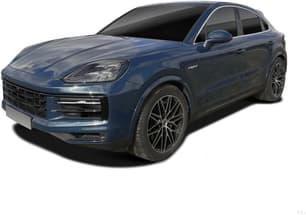
What's the difference?
The Porsche Cayenne Turbo GT needs a better name. This is the king of Cayennes and quite possibly the ruler of all super SUVs.
Well, the Cayenne Turbo GT is the fastest SUV around the Nurburgring Nordschleife. Not just that, it has such colossal power and torque it'll be side-by-side with a Porsche 911 GT3 RS in a sprint from 0-100km/h. No, a better name for this SUV would be the Cayenne GT3.
Which is perfect for me because I'm at the point in my life where although I love full-on and noisy cars I also have a full-on and noisy family.
We lived with the Cayenne Turbo GT for a week to find out if this super SUV was also a super family car - from practicality to safety.
We're also a family with ridiculously high expectations of luxury SUVs having lived with and tested each of the Cayenne Turbo GT's rivals - from the Lamborghini Urus and Bentley Bentayga to the Aston Martin DBX and Alfa Romeo Stelvio Quadrifoglio.
Mercedes-Benz loves to fill a niche. This is the company, after all, that has a coupe version of its GLC and GLE SUVS, four-door coupes ranging in size from the CLA to the AMG GT 4-door, and enough electric vehicles to make Tesla jealous.
The nichest of all though, might the CLS, which has been updated for the 2022 model year.
Positioned above the E-Class but below the S-Class in the line-up as a sporty sedan for customers after a blend of style, technology and performance, the new CLS is available in just one engine now, while styling and equipment have also been tweaked in the update.
Can the CLS earn its place in the Mercedes line-up or is it destined to be a bit player amongst more popular models?
Of all the super SUVs I've piloted, the Porsche Cayenne Turbo GT is the best all-rounder in terms of performance, comfort, cabin technology and style.
As a family car it's roomy, practical and easy to use and drive daily.
As a performance car the Turbo GT is stupidly quick, with the agility of a sports car. Sure, a 911 would leave it behind on a twisty race track, but this SUV is close to having that sportscar experience and keeping your family, as well.
Comfortable when it needs to be and sporty when you want it to be, the CLS 53 is a bit like Mercedes’ Doctor Jekyll and Mr Hyde – or maybe Bruce Banner and the Hulk is a better frame of reference for some.
While it doesn’t excel in any one particular area, its breadth of useability is commendable, but ultimately it might be its all-too-familiar aesthetics that is the biggest letdown.
From the inside, it looks and feels like any other large Mercedes model (not necessarily a criticism), while the exterior – in my opinion – doesn’t go far enough to differentiate it from the CLA.
After all, if you wanted a stylish and sporty sedan, shouldn’t feel special too?
This might be a personal thing but to me nearly all Porsches look better from the back than the front.
It's the wide stance and powerful haunches, the hunkered down suction-capped-to-the-road look that does it for me and the Cayenne Turbo GT, despite being an SUV, passes this important Porsche checklist item.
The GT aero kit only serves to make this SUV look more of a beast, and the gold-bronze looking satin Neodyne wheels are a Porsche theme that I've not always been a fan of, but I get the historic connection.
If only the Turbo GT could look a little less like other Cayennes from the front. This is the king of the SUV range and despite the apron and bumper already being exclusive to this model, there should be more.
Vents in the wheel arches, carbon bonnet with nostrils GT3-style perhaps? Or is that going too far? If you do want something more lairy then there's always the Urus.
The Cayenne Turbo GT's cabin is stunning in its plushness and modern surprises such as the passenger display, the hoodless instrument digital cluster, the lashings of Race-Tex upholstery everywhere. It's perfectly Porsche. High-performance meets high-end.
It's also highly practical. Let's talk about that.
Mercedes’ homogenised design is a bit of a double-edged sword, and while the CLS does wear its styling confidently, it probably looks a little too much like the cheaper and much smaller CLA for our tastes.
Both are swoopy four-door coupes from Mercedes-Benz, so of course there will be some similarities, but keen-eyed car spotters will notice some differences.
While the proportions are similar, the longer wheelbase and bonnet line gives the CLS a more mature look, and the extra details found in the head- and tail-lights, and front bumper stand it apart.
The changes to the 2022 version also brings in AMG’s 'Panamericana' front grille, which adds a bit of welcome aggression to the front end.
From the side, the steeply raked roof flows seamlessly into the rear, while the 20-inch wheels fill out the arches well.
All four doors are also frameless, which is always cool to see.
From the rear, quad-exhaust tips hint at the CLS’s sporty intentions, while a prominent rear diffuser and subtle boot lid spoiler also feature.
Inside, the biggest change to the CLS is now the inclusion of the MBUX multimedia system, which keeps it in line with the E-Class, C-Class and other Mercedes models.
AMG sports seats are also fitted, wrapped in Nappa leather and 'Dinamica' fabric upholstery for all pews.
Our test car also came fitted with red contrast stitching and seat belts, adding a racy streak to the CLS cabin.
Have to point out the new steering wheel that comes with the 2022 CLS, though, which mirrors the tiller offered in the new E-Class, and is a step back in terms of functionality.
It looks premium enough thanks to its chunky leather-wrapped rim and gloss black dual-spoke design, but using the buttons, especially when on the move, is difficult and unergonomic.
This design is definitely function over form, and might need a few more revisions to get it right.
Overall, we’d say the CLS is a good-looking car, but does play it a bit too safe with its styling?
The Porsche Cayenne Turbo GT only makes one compromise on practicality and that's the removal of the middle seat in the back, which, with just two kids isn't used all the time but on average we might need it once a week for school mates and cousins.
Instead of a middle seat there is a shallow tray, which will fit a phone or in our case leaves and rocks found at the park.
So, yes, the Turbo GT is a four-seater only, but this is a spacious, large SUV with good head and legroom, wide-opening doors for easy entry and exit, and air suspension which can raise and lower the height for easy access.
Storage is excellent with enormous door pockets in the front and back and there are four cupholders.
There's a wireless phone charger in the front and two USB-C ports as well, plus two USB-C sockets in the back.
Four-zone climate control means the kids in the back can set their own temperatures. They also have heated seats.
I was disappointed to see there aren't sunshades for the rear windows - pretty vital in Australia where it feels like we're only about 50 metres away from the sun.
The Turbo GT's 576-litre boot just managed to fit our pram and a week's shopping, which is our minimum standard for living. Any more space is a bonus.
Measuring 4994mm long, 1896mm wide, 1425mm tall and with a 2939mm wheelbase, the CLS slots neatly between the E-Class and S-Class in size and positioning.
Up front, occupants are afforded ample room for head, legs and shoulders, while the electronically adjustable seats make it easy to find a comfortable position.
The steering wheel also features a telescoping function – an always appreciated feature – and the expansive glasshouse makes things feel open and airy.
Storage options include a deep door pocket, a cubby found under the armrest, two cupholders and a smartphone tray with wireless charging capabilities.
It’s a different story in the second row, though, as the sloping roofline does noticeably eat away at headroom.
Don’t get me wrong, a six-foot-tall (183cm) adult can still slide in there fine, but the roof is dangerously close to the touching the top of the head.
Leg- and shoulder-room is pretty good in the outboard seats though, while the middle position is compromised by the intrusive transmission tunnel.
In the second row, passengers have access to a bottle holder in the door, a fold-down armrest with cupholders, backseat map pockets and two air vents.
Opening the boot reveals a cavity offering 490 litres of volume, with an aperture wide enough to fit golf clubs or luggage for a weekend getaway for four adults.
The rear seats also fold in a 40/20/40 split fashion, but Mercedes-Benz is yet to detail how much volume is on offer with the rear seats down. And as a traditional sedan, the CLS is less practical than the liftback Audi S7.
The Turbo GT is the king of Cayennes, so it shouldn't surprise anybody that it's also the most expensive with its list price of $364,700.
Lamborghini's Urus lists for $409,744 and is the Cayenne Turbo GT's not-so-subtle Italian cousin, sharing the same platform and engine.
Both are in my mind the best performance SUVs on the planet. It just depends how conspicuous you want to be.
Then there's Bentley's V8 Bentayga which isn't blessed with the Porsche's good looks but would still be all over the Cayenne if the two happened to meet at a race track.
So, why is the GT Turbo the king of the Cayennes? What makes it better? For all the reasons you'd think - it's the fastest, most powerful, most luxurious and most equipped Cayenne in the range.
We'll get into mind-bending engine and performance specs soon, but first let me take you through the standard features on a car that's anything but standard.
Coming standard and exclusively to the Turbo GT are 22-inch 'GT Design' wheels in satin 'Neodyne' with full-colour Porsche centre caps, an active rear spoiler, Turbo GT front apron, dual titanium exhaust, rear apron with diffuser, 'SportDesign' side skirts, wheel arch extensions, a lightweight carbon roof and tinted LED HD-matrix headlights.
Inside, and also exclusive to this grade, is the 'GT Interior Package' with 'Race-Tex' upholstery throughout with 'Deep Sea Blue' stitching on the front seats and centre console and the armrests and dashboard.
There's also the 'Carbon Interior Package' which includes dashboard and door trim elements.
Race-Tex trim is applied to the 'GT Sports' steering wheel, roof lining and gearshift, too.
The adaptive active air suspension, which can lower the car by 15mm, is standard and only available on the Turbo GT, too.
The soft-close doors are standard (a cost option on lower grades), as are the stainless steel pedal covers.
The rest of the features are also found on lower grades and include the 12.65-inch digital instrument cluster, head-up display, proximity unlocking, 12.3-inch multimedia touchscreen with sat nav, wireless Apple CarPlay and Android Auto, digital radio, a 10-speaker Bose sound system, heated front seats, rear privacy glass and an auto tailgate.
Four-zone climate control is standard on the GT Turbo, too, and so are heated rear seats.
Our car had several options fitted such as the front passenger display ($2860) and the Deep Sea Blue Accent Package.
The passenger display is a crowd pleaser, but as a family car my kids felt like they were missing screens in the back seats, too. Well, in my day...
When the third-generation Mercedes-Benz CLS-Class hit Australian showrooms in 2018, it was available in three flavours, but the 2022 refresh has trimmed the line-up to just one – the top-spec AMG-tuned CLS 53.
The discontinuation of the entry-level CLS350 and mid-tier CLS450 means the CLS-Class now kicks off at $188,977, before on-road costs, which makes it more expensive than rivals like the Audi S7 ($162,500) and Maserati Ghibli S GranSport ($175,000).
With BMW ditching the 6 Series, the Bavarian brand doesn’t offer a direct rival to the Mercedes-AMG CLS 53, but its bigger 8 Series is offered in a Gran Coupe body style that starts at $179,900.
So, what does Mercedes include in the CLS’s asking price?
Standard equipment includes interior ambient lighting, a head-up display, 12.3-inch digital instrument cluster, power-adjustable and heated front seats, woodgrain interior trim, powered boot lid, rear privacy glass, push-button start, keyless entry, and a sunroof.
As an AMG model, the 2022 CLS is also fitted with a unique steering wheel, sports seats, illuminated door sills, drive mode selector, 20-inch wheels, a performance exhaust, boot lid spoiler and blacked-out exterior package.
Handling multimedia duties is a 12.3-inch 'MBUX' (Mercedes-Benz User Experience) touchscreen, with functions including Apple CarPlay/Android Auto connectivity, digital radio, a wireless charger, satellite navigation and a 13-speaker Burmester sound system.
It’s a long and fully-featured equipment list, for sure, and it’s so extensive that there aren’t really any options available.
Buyers can opt for an 'AMG Exterior Carbon Fibre Package', power-closing doors, and different finishes for the exterior paint, interior trim and seat upholstery – that’s it!
While its nice that everything you’d want comes included in the asking price, it’s hard to ignore the fact that its Audi S7 rival is more than $20,000 cheaper, but also well equipped.
As a middle-aged parent with two children, a Porsche that I don't have to crawl into and out of like a cubby house is a great thing.
What's even better is that this ‘easy access' Porsche is every bit as brutally powerful and fast as the quintessentially ‘pure' Porsche, the 911. Actually, it's more powerful and faster.
The Turbo GT's twin-turbo 4.0-litre V8 petrol engine makes 485kW and 850Nm with drive going through an eight-speed transmission to all four wheels.
In comparison, a Porsche 911 GT3 RS, arguably the most brutal and anti-social 911, has 386kW/485Nm.
I haven't made a mistake. Those are the real numbers. And it's only when you step on the accelerator in the Cayenne Turbo GT, and it feels like somebody's sat down on your chest, that you realise what a big deal this is.
That is such a colossal amount of oomph that this 2.2-tonne family SUV can accelerate from 0-100km/h in 3.3 seconds.
The 911 GT3 RS can do it in 3.2 and it has a roll cage and a fixed rear wing the size of a bedroom door.
And yes, we're now coming into a digital age where Teslas and other electric SUVs are quick, too, but can they go around corners like a Porsche Cayenne Turbo GT?
Do they have the same rumble and roar as a twin-turbo V8 that's terrifying and enticing at the same time.
The correct answer is, absolutely not.
Powering the Mercedes-AMG CLS 53 is a 3.0-litre turbocharged inline six-cylinder engine, punching out 320kW/520Nm to all four wheels via a nine-speed automatic transmission and Merc's '4Matic+' AWD system.
A 48-volt mild-hybrid system, known as 'EQ Boost', is also fitted that serves up to 16kW/250Nm from take-off.
The result is a 0-100km/h acceleration time of 4.5 seconds, keeping it on pace with the likes of the 331kW/600Nm Audi S7 (4.6s) and 390kW/750Nm 250kW/500Nm BMW 840i Gran Coupe (5.2s).
While not as brutish as AMG’s eight-cylinder engine, the straight six strikes a great balance between pace and poise that perfectly suits a model like the CLS 53.
Seriously? This is a 2.0-tonne twin-turbo petrol V8 with a 90-litre fuel tank. Even the Porsche specs sheet doesn't understand the question because in the column for fuel efficiency there are three letters - tbc.
My own testing saw me record 22.5 L/100km at the fuel pump, which means I enjoyed driving the car very much.
A little digging around reveals Porsche globally claims the Turbo GT will use 12.6L/100km, over a combination of open and urban roads.
You might not have as much fun as I did but easing back a little might get you closer to the 700km of range this more frugal consumption figure appears to offer.
While efficient it isn't, I'm not going to mark the Turbo GT too much here because compared to its petrol rivals the fuel consumption is what I'd expect from such a high-output heavy SUV.
Official fuel consumption numbers for the CLS 53 are pegged at 9.2 litres per 100km, while we managed an average of 12.0L/100km in our launch drive.
All of our driving was relegated to country back roads and high-trafficked urban areas however, with no consistent freeway driving.
We’ll reserve judgement on how accurate the fuel economy figures are until after we’ve had the car for longer, but the EQ Boost system is designed to help keep consumption down by being able to coast the engine in particular situations.
Never have I met a car this powerful and superbly athletic that is as pleasurable to drive alone on great, fast roads as it is to pilot at 50km/h in the suburbs with a family on board.
It exceeds my understanding of engineering that something this large can move so quickly. That in an instant can turn and tip into a corner with such precision and effortlessness.
Yet it can switch seamlessly and happily to coping with speed bumps and potholes, delivering a ride so comfortable it'll send babies off to sleep. And it did.
The only issue, and this is such a tiny thing, is the dash-mounted gearshift, which means having to reach up and select Drive or Reverse or Park, which, when executing a three-point turn, is necessarily frustrating.
Still, I'm giving the Turbo GT a 10 out of 10 for driving under all conditions, and we didn't even go off-road, which of course you can do, as long as it's not too wild.
There are certain expectations on a vehicle when it wears a Mercedes badge, namely it should be comfortable to drive while also dripping with the latest tech. And here the large four-door coupe delivers in spades.
Driving the car is smooth, easy and comfortable when in its default drive setting, you can really sink into the CLS and just eat up the miles in comfort.
There are small niggles, like the 20-inch wheels and low-profile tyres (245/35 front and 275/30 rear) throw up a bit too much road noise into the cabin, but for the most part, around town, the CLS is serene, supple and supremely soothing.
However, switch it over to Sport or Sport+ and the steering gets a bit heavier, the throttle response a bit sharper, and the suspension a bit stiffer.
Does it transform the CLS into a sports car? Not quite, but it certainly dials up driving engagement to a level where you can really have some fun.
Though this isn’t a full-fat AMG in the same vein as an E63 S and doesn’t feature the ubiquitous 4.0-litre twin-turbo V8, the CLS 53’s 3.0-litre six-cylinder engine is still plenty potent.
Coming away off the line feels particularly brisk, likely due to the EQ Boost system adding a bit of poke, and even flat-footing it mid-corner delivers a noticeable surge of urgency from the creamy straight six.
However, the best of the CLS 53 experience, in my opinion, is actually the sound, with the exhaust letting off the right sort of pops and crackles in Sport+ mode on overrun.
It’s rude and obnoxious, but also completely surprising coming from the motoring equivalent of a three-piece dress suit – and I love it!
The brakes are also up to task for scrubbing speed, but our relatively brief time with the car was in extremely wet conditions, so the 4Matic+ AWD system was hugely appreciated.
The Porsche Cayenne Turbo GT hasn't been locally crash tested and so doesn't have an ANCAP rating.
That's quite normal for super high-end cars. But, when this third-generation model first arrived in 2017 it was tested by ANCAP's European equivalent, Euro NCAP, and was awarded the maximum five stars.
There's AEB which operates at city, urban and highway speeds, and lane keeping assistance, and lane change assistance which is a form of blind-spot warning, and adaptive cruise control. You can option rear cross-traffic alert, as well.
A space saver spare wheel is under the boot floor.
The Mercedes-Benz CLS is yet to be tested by ANCAP or Euro NCAP, which means there is no official crash-test rating that applies to local market vehicles.
However, the standard safety equipment list is extensive, and covers autonomous emergency braking (AEB), nine airbags, rear cross-traffic alert, blind-spot monitoring, tyre pressure monitoring, a surround-view camera, route-based speed recognition and lane-change assist.
The rear seats also feature two ISOFIX mounting points for child seats.
The Cayenne Turbo GT is covered by Porsche's three-year, unlimited kilometre warranty, which is lagging behind in terms of duration even compared to other luxury brands such as Mercedes-Benz, which offers five years.
Servicing is recommended annually or every 15,000km, although there isn't a capped price maintenance plan with final costs determined at the dealer level (in line with variable labour rates by state or territory).
Like all new Mercedes-Benz models sold in 2021, the CLS 53 comes with a five-year/unlimited kilometre warranty with roadside assist over that period.
This outclasses the assurance period offered by BMW, Porsche and Audi (three-year/unlimited kilometre), and matches that available from Jaguar, Genesis and Lexus, who recently upgraded their offering.
Scheduled service intervals are every 12 months or 25,000km, whichever occurs first.
The first three planned services will set buyers back $3150, broken down as $700, $1100 and $1350 apiece.