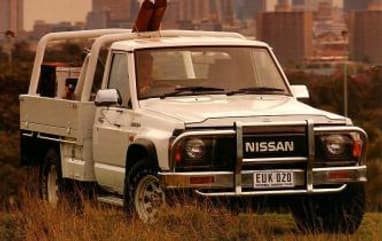
Nissan Patrol 1998 Problems

Are you having problems with your 1998 Nissan Patrol? Let our team of motoring experts keep you up to date with all of the latest 1998 Nissan Patrol issues & faults. We have gathered all of the most frequently asked questions and problems relating to the 1998 Nissan Patrol in one spot to help you decide if it's a smart buy.

Used Nissan Patrol review: 1997-2001
By Graham Smith · 16 Apr 2005
There are four-wheel drives and there are four-wheel drives.  There are those that spend their time doing the rounds in town, while looking like they could go bush if need be, and there are those that are designed to do their time deep in the mulga, but get bogged down in the 'burbs.Two vehicles fit into the latter category – Toyota's Land Cruiser and Nissan's Patrol.Both are serious four-wheel drive wagons, capable of plunging deep in the bush or towing a heavy load. They're heavy duty workhorses, at their best on the job.Model watchIn 1997, the GU Patrol replaced the popular GQ, a rough and tough four-wheel drive wagon that had a big following.  The Patrol follows common practice in this class of off-roader with a wagon body perched atop a separate chassis which is considered the best way of tackling the toughest of conditions a vehicle might encounter.A separate chassis has the effect of raising the cabin quite high off the ground and it also cuts down on the interior space.  Nissan offered a choice of one petrol and three diesel engines. The petrol engine was a 4.5-litre single overhead camshaft fuel-injected six-cylinder unit with a chain driven camshaft and put out 145kW.Performance with the petrol engine was good and the fuel consumption was acceptable. The diesel choices were a 2.8-litre single overhead camshaft turbo diesel six-cylinder engine producing 95kW, a 4.2-litre overhead valve delivering 91kW, and a 4.2-litre overhead valve turbo diesel pumping out 114kW.The 2.8-litre turbo diesel was replaced by a 116kW 3.0-litre in 2000 in the GU II update, and with it came plenty of trouble (see In The Shop).  Performance of the diesels wasn't as punchy, but the low-down grunt they delivered was welcome, along with the fuel consumption savings.Drive was through all wheels, with a choice of two-wheel drive for the highway and dual-range four-wheel drive for off-road use. Front hubs were manual locking on the entry level DX model, but the others had auto hubs.  Buyers could choose between three models -- the DX five-seater, the popular seven-seater ST and the top of the range Ti.In the shopWhile the Patrol is generally a rough and rugged vehicle with few faults, there is a cloud hanging over the 3.0-litre turbo diesel. The problem generally manifests itself in the form of melted pistons, but the most likely explanation is that it's caused by a piston oiling/cooling problem.Not all engines are affected. Those most likely to succumb to the problem are those doing a lot of highway cruising.  Nissan has increased the oil fill and played with alignment of the nozzles that spray oil on the pistons for cooling and lubrication purposes, but there seems to be no consistent fix for the problem.Its important to keep an eye on the oil level in all engines but particularly so in the 3.0-litre turbo diesel.  Apart from the 3.0-litre turbo diesel engine's woes, the Patrol is generally a tough and rugged vehicle that gives good service over the long term.That said, the manual gearbox can have problems with the fifth gear spline and hub.  It's important to check for a service record, particularly if the vehicle has spent time off-road. It's also important to check under the vehicle for damage sustained off-road, like bashed suspension and chassis components, brackets, exhaust etc.On the exterior, look for scratches and scrapes from trackside bushes during road excursions.  Consider carefully before buying a Patrol that has clearly been off-road as there are plenty that haven't spent much time off the black top and they are a better choice.Rating14/20 Comfortable and well equipped small car makes sense for family transport around town.
Read the article
Used Nissan Patrol review: 1996-2015
By Ewan Kennedy · 03 Feb 2016
Ewan Kennedy reviews the GQ, GU and Y62 Series Nissan Patrol from 1996,1997,1998,1999, 2000, 2001, 2002, 2003, 2004, 2005, 2006, 2007, 2008, 2009, 2010, 2011, 2012, 2013, 2014, and 2015 as a used buy.
Read the article
Used Nissan Patrol review: 1997-2001
By Graham Smith · 29 Jan 2009
There are four-wheel drives and there are four-wheel drives. There are those that spend their time doing the rounds in town, while looking like they could go bush if need be, and there are those that are made to do their time deep in the mulga, but get bogged down in the ’burbs.Two vehicles fit into the latter category, no argument, Toyota’s LandCruiser and Nissan’s Patrol. They’re the two heavyweights that slug it out for the bush bragging rights.The LandCruiser had a head start. It was here first, won an enviable reputation on the Snowy Mountains project in the 1950s, built on it on mining and construction sites in the most remote parts of the country in the years since, but the Patrol has plenty of fans as well.Both are serious four-wheel drive wagons, capable of plunging deep in the bush or towing a heavy load. They’re heavy-duty workhorses, at their best on the job.The GU Patrol replaced the popular GQ in 1997. Coming after the GQ, a rough and tough four-wheel drive wagon that had a big following, the GU had some big tyre tracks to follow.The Patrol follows common practice in this class of off-roader with a wagon body perched atop a separate chassis, which is considered the best way of tackling the toughest of conditions a vehicle of this type might encounter.That not only makes it tough, it also makes heavy. The heaviest model the in the range, the 4.2-litre turbo diesel, weighs in at a fraction over 2.4 tonnes, which has an affect on performance, fuel consumption, handling and braking.A separate chassis also has the affect of raising the cabin quite high off the ground, which makes it a bit of a climb to get in to. It also cuts down on the interior space, and the Patrol is surprisingly tight inside given its overall size.Nissan offered a choice of one petrol and three diesel engines. The petrol engine was a 4.5-litre single overhead camshaft fuel-injected six-cylinder unit that had a chain driven camshaft and put out 145 kW.Performance with the petrol engine was good considering the massive hulk it was trying to move, and the fuel consumption was acceptable for the same reasons.The diesel choices were a 2.8-litre single overhead camshaft turbo diesel six-cylinder engine producing 95 kW, a 4.2-litre overhead valve delivering 91 kW, and a 4.2-litre overhead valve turbo diesel pumping out 114 kW.The 2.8-litre turbo diesel was replaced by a 116 kW 3.0-litre in 2000 in the GU II update, and with that came plenty of trouble.Performance of the diesels wasn’t as punchy, but the low down grunt they delivered was welcome along with the fuel consumption savings.There was also a choice of a five-speed manual gearbox or a four-speed auto trans.Drive was through all wheels, with a choice of two-wheel drive for the highway and dual-range four-wheel drive for off-road use. Front hubs were manual locking on the entry level DX model, but the others had auto hubs so you could switch from two-wheel drive to four-wheel drive high range on the move.Buyers could choose between three models. The DX five-seater kicked off the action with steel wheels, power steering, vinyl trim and floor mats, basic sound, limited-slip diff, manual hubs.The popular seven-seater ST also had side steps, wheel arch flares, more civilised cloth trim, carpets, central locking, power windows and mirrors, cruise, console, better sound, CD player and map lamps.Atop the range was the Ti, the burger with the lot, which added alloy wheels, auto air-con, remote central locking, ABS, superior sound, leather trim, power driver’s seat, and two-tone paint.While the Patrol is generally a rough and rugged vehicle with few faults, there is a cloud hanging over the 3.0-litre turbo diesel. The problem generally manifests itself in the form of melted pistons, but the most likely explanation is that it’s caused by a piston oiling/cooling problem.Not all engines are affected, those most likely to succumb to the problem seem to be those doing a lot of highway cruising.Nissan have increased the oil fill, and played with alignment of the nozzles that spray oil on the pistons for cooling and lubrication purposes, but there seems to be no consistent fix for the problem.It’s important to keep an eye on the oil level in all engines, but particularly so in the 3.0-litre turbo diesel.Apart from the 3.0-litre turbo diesel engines woes the Patrol is generally a tough and rugged vehicle that gives good service over the long term.That said the manual gearbox can have problems with fifth gear spline and hub.It’s important to check for a service record, particularly if the vehicle has spent time off road.It’s also important to check under the vehicle for damage sustained off road, like bashed suspension and chassis components, brackets, exhaust etc.On the exterior look for scratches and scrapes from trackside bushes during of road excursions.Consider carefully before buying a Patrol that’s clearly been off road as there are plenty that haven’t spent much time off the black top and they are a better choice.It’s good to have mass on your side in a crash so the Patrol will provide protection if you hit a smaller vehicle when it will inflict considerable damage on the other car.The separate chassis construction, however, doesn’t perform as well in a crash situation as does a mono-construction body, which crumples in a more controlled way and absorbs the crash energy better.In a crash where the Patrol hits a larger, more solid object then occupants are likely to suffer greater injuries than if they were in a regular passenger car.It’s also worth remembering that because of its mass the Patrol takes longer to react, to the steering or brakes, in an emergency situation.All models except the DX had a driver’s airbag from the beginning, the DX joined the club in 2000 with the GU II update. The Ti had dual airbags.Ed Niemiec owns a 2000 GU II Patrol with the new 3.0-litre turbo diesel, and says it’s the best car he’s ever owned. He uses it in his work as a quantity surveyor with a need for high ground clearance and room to carry gear. It has now done 125,000 km, and apart from normal servicing, he has replaced the tyres and front disc pads. The fuel consumption has always been between 11 and 12 L/100 km. It has never missed a beat, he says, and sits on the highway like a dream. His only complaint is that he had to modify the suspension to handle the loads he has to carry.Nissan replaced the pistons and rings in Rex Rickard’s Patrol at 28,500 km, after which it suffered intermittent power loss and poor fuel consumption. Nissan has since replaced the air flow sensor, the injector pump, injectors, and the computer, and now say they can do no more. A lack of response to his phone calls has added to his frustration with his dealer and with Nissan.Colin Lockyer has a 2000 3.0-litre diesel Patrol, which he says is great, but he knows of five others that have melted piston number five at around 100,000 km and is concerned his, which has done 98,000 km, might suffer the same fate.• Avoid the GU II 3.0-litre turbo diesel engine• Reliable apart from 3.0-litre turbo diesel engine• Serious offroader at its best in the bush• Bulk makes it less responsive in an emergency situation• Poor fuel consumption• Small cabin for its overall sizeTough truck best suited to serious offroad use or heavy towing, but really unsuitable for every day use around town. Don’t touch the 3.0-litre turbo diesel GU II.
Read the article
Nissan Patrol 1998: Is regular unleaded fine?
Answered by Graham Smith · 09 Jun 2005

UNLEADED should be fine for your car. We checked with Nissan and they agreed that unleaded is the way to go.

My 1998 Nissan Patrol GU won't engage four-wheel-drive
Answered by David Morley · 08 Aug 2025

This mightn’t be too hard to figure out as the GU Patrol used a purely mechanical engagement system for the transfer case and four-wheel-drive system. Unlike newer designs with rotary knobs and electronic control, there’s really not to much to go wrong with the Patrol’s setup assuming it’s a selector problem. Make sure the selector rods are all connected properly and that they’re not binding or loose under the car.

However, if the lever is engaging and the front drive-shaft is not turning the front wheels, then you may have a hub problem. Free-wheeling hubs are great for saving fuel, but when they go wrong, it can often mean the drive doesn’t reach the front wheels. At that point, you have a bigger job on your hands. The same symptoms could also be a result of a broken front differential which is not sending the drive out to the front wheels. Finally, the transfer-case itself may be at fault. If it’s not sending the drive forward, there’s no way the vehicle will achieve four-wheel-drive.

Also, to maximise your chances of engaging four-wheel-drive, make sure the vehicle is stationary at the time and the transmission is in neutral. In fact, this is essential for moving between two and four-wheel-drive in many types of off-roader.

Nissan Patrol 1998: How to adjust idle speed?
Answered by Carsguide.com.au · 05 Jun 2003

According to Nissan the correct idle sped for your Patrol is between 750 and 800 revs, so your vehicle is within specification. Nissan says you can't adjust the idle speed manually as it is controlled by the electronic control module (ECM) and must be checked by a Nissan dealer. If you have any further concerns, a diagnostic check by a Nissan dealer can establish if there is a problem, and if so, which sensor is causing the variation in the idle speed.

You could be looking at something internally wrong with the transmission, but the clue that this might be something simpler is in the way the engine will start in Reverse which, of course, it shouldn’t (for safety reasons). The suspicion would be that the relationship between the selector (inside the cabin) and the actual gearbox is somehow out of synch. So when the selector is telling you the car is in Reverse, it’s actually in Park or Neutral, which is why the engine will start.

That might also explain why the car won’t select fourth gear; the position that actually coincides with Drive (or fourth gear) looks – from inside the cabin – to be the Neutral position. So, to check this, put the car in what looks like Neutral and, in a safe place, see if it moves when you give it some throttle.

Failing that, you’ve got two separate problems. The first is the inability to select fourth gear (which could be a hundred things) and a failure of the safety switch which is allowing the engine to start in Reverse.

Nissan Patrol 1998: Hard start issue
Answered by Graham Smith · 23 May 2014

It's frustrating when a dealer misdiagnoses a problem, and then charges you for the work they've done, even though it hasn't fixed the so-called problem. In this case, from what you have told us, there really isn't a problem. You say you are able to start the car first time, every time, by simply waiting a second or so longer, it was only the dealer that claimed it was hard to start. I wouldn't trust the dealer and would take the car to someone else if you feel you need to have it checked further, in this case one who specialises in diesels.

THERE are too many reports circulating about the 3.0-litre turbo diesel engine and Nissan won't discuss them, so it's hard to recommend the engine to anyone. If you're thinking of the 4.2-litre I would suggest you go for that and stay away from the 3.0-litre engine.

Disclaimer: You acknowledge and agree that all answers are provided as a general guide only and should not be relied upon as bespoke advice. Carsguide is not liable for the accuracy of any information provided in the answers.
Have a new question for the CarsGuide team?
More than 9,000 questions asked and answered.
Complete guide to Nissan Patrol 1998
Complete guide to Nissan Patrol 1998 CarsGuide Logo
Reviews, price, specs and more