









Many road cars are beaten by race track driving. Brake pads crumble, tyres disintegrate, clutches cook and the odd engine lets go. The 911 GT3 is different. A car that can be driven every day, the hot Porsche came away from a relentless pounding at Queensland Raceway in perfect condition.
At $253,200, the GT3 sits above the regular 911 Carrera ($198,100), but below the all-conquering 911 Turbo ($327,000). It looks similar to a regular 911, apart from a monster wing, deep bumpers and those 11-inch wide rear wheels, but is a race car in disguise.
The cars at the launch were also fitted with carbon-fibre race seats, a half roll cage, six-point driver's harness and a fire extinguisher as part of a $12,500 pack.

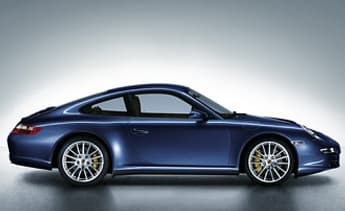

The GT3 is more than a tweaked version of the 911. Instead of running the same 239kW 3.8-litre six-cylinder Boxter, the GT3 runs a 3.6-litre six pack that generates an incredible 305kW without a turbo or supercharger.
The rear-mounted unit also generates an impressive 405Nm of torque. The engine is an evolution of the previous GT3 unit, but fine-tuned to improve responsiveness throughout the rev range. Pistons, con-rods and crankshaft have been lightened and rev-limit increased to an impressive 8400rpm.
Road cars usually feel slow in the wide, open spaces of a race track, but not the GT3.
It has enough punch to launch from 0-100km/h in just 4.3 seconds.
The main issue is trying to stop the back from stepping out under acceleration. Its huge rear tyres struggle to handle the power.
The GT3 has a wonderful meaty sound that only a boxer engine can deliver.
A six-speed manual is standard; there is no automatic option. The GT3 uses a limited slip differential to get the power down, while electronic traction and stability control are there if things get out of hand.
The stability control, which can be turned off, is configured for track work and allows some drift before it intervenes.
Porsche has fitted the GT3 with active suspension, which adjusts damping rates to road conditions and can be locked in a firmer mode for track work. Porsche has further developed the braking to cater for the dramatic increase in horsepower. Six-piston calipers bite into massive cross-drilled 350mm diameter discs up front, while four-pot calipers pull up rear discs of the same size.
The brakes take a beating on our track test and the pedal does go a little soft after several hot laps, but it doesn't matter much — you just have to press a bit more firmly.
Steering is a regular power-assisted hydraulic system that gives the driver high levels of feedback and feels millimetre perfect. Given our test was carried out on the racetrack, it's impossible to say what the car would be like to drive on the road.
The track makes it clear that as a race car, the GT3 is both brilliantly quick and impressively sturdy.
At the Porsche Sports Driving School you can drive a GT3. Find out more here.
Related cars for sale on CarsGuide
See more Porsche 911s for sale View cars for salePorsche 911 2007: Gt3
| Engine Type | Flat 6, 3.6L |
|---|---|
| Fuel Type | Premium Unleaded Petrol |
| Fuel Efficiency | 19.8L/100km (combined) |
| Seating | 2 |


.jpg)


.jpg)
.jpg)
.jpg)
.png)
.jpg)
.png)
.jpg)
.jpg)
