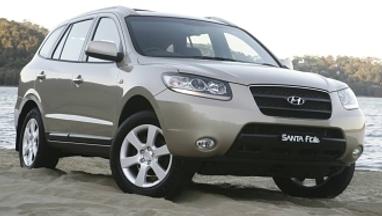
Are you having problems with your 2007 Hyundai Santa Fe? Let our team of motoring experts keep you up to date with all of the latest 2007 Hyundai Santa Fe issues & faults. We have gathered all of the most frequently asked questions and problems relating to the 2007 Hyundai Santa Fe in one spot to help you decide if it's a smart buy.
Don Bate bought his 2009 Hyundai Santa Fe SLX diesel manual in 2011 when it had done 25,000 km. It has now done 72,000 km, 30,000 of which have been towing his 1750 kg caravan. He says the Santa Fe is a superb towing vehicle. It gets 7.2 L/100 km around town and 10.5 L/100 km towing on the highway. The clutch had to
Larger than average for its class, the Hyundai Santa Fe is a popular SUV that can be used as a family car provided the offshoots haven’t reached their hulking-teen stage.There's good legroom in the rear, but some of that legroom has been gained by stealing space from the front seat occupants. A third-row seat option arrived in the all-new model in 2006. As good luggage space, including side bins and hidden storage space under the floor panel. A retractable blind and luggage net combine to improve safety and security. The rear glass can be opened separately if you don’t want to lift the whole tailgate, a real convenience in cramped carparks.Off-road Santa Fe's better than average for its class and can cope with harsher conditions than those likely to be demanded by the typical owner. It really is a 4WD, not simply an SUV. But don’t mistake if for a full house off-roader or you may get yourself into stuck in awkward areas. The Santa Fe first reached Australia in 2000 and sales were moderately good from the start, though it its somewhat over-the-top styling didn’t appeal to everyone.An all-new, larger, model was launched in May 2006 with a more mainstream look that saw it pick up a lot of buyer interest. The 2006 model was offered with a third row of seats for the first time. As in any vehicle of this size, the extra row of seats steals a lot of the boot area. Ride comfort is generally good and handling is nicely sorted for Australian conditions.The Koreans really seem to have a feel for what Australian drivers like in their vehicles. In the bush the Santa Fe copes well with corrugations, in the suburbs speed-bumps seldom cause any real grief. Santa Fe originally arrived only with the power of Hyundai's 2.7-litre V6 engine, but the range was expanded in 2001 when a four-cylinder 2.4-litre unit arrived. The four-cylinder engine wasn’t all that popular and was taken off the Australian market towards the end of 2003. That’s no reflection on the four-cylinder engine itself and it should make a good used-car buy.Four-cylinder engines in a car of this size can be a bit of a compromise in performance and Hyundai was smart in only importing it with a five-speed manual version as an automatic could have taken away enough grunt to make it unacceptable for some drivers. All V6-powered Santa Fe models have a four-speed automatic transmission. The V6 auto has a sequential function to give the driver a fair degree of manual control and is useful for getting the best from the engine.From late 2006, Hyundai offered its Santa Fe with a turbo-diesel engine for the first time in Australia. The potential fuel savings make it worth hunting down. The Hyundai dealer network is large and generally widespread in Australia. Because most Santa Fe 4WDs are used in the metropolitan areas dealers aren't that common in the bush, so check in our local area to make sure spares and service are on offer close handy. Spare parts prices are about average for this class.Santa Fe is fairly traditional in its mechanical makeup and the good home mechanic will find themselves able to do much of the work. It always pays to have a good workshop manual at hand, and don’t attempt any safety related repairs unless you really know what you are doing.Insurance charges are moderate, though there does seem to be a bigger than average spread of premiums between companies. So it’s worth taking the time to shop around for the best deal for your circumstances.Hyundai Santa Fe works extremely well considering it’s the company’s first attempt at a vehicle in this class. It has since been joined by the slightly softer Tucson SUV and the tough Terracan off-roader, thus making Hyundai very much an integral part of the booming Australian 4WD/SUV scene.WHAT TO LOOK FORLook over the interior for signs of it having had a hard time at the hands of uncaring children. Build quality is generally good, but there can be the occasional rough one.Check for signs of underbody damage caused by harsh off-road use. The body corners and doors sills are often the first to suffer. Also look at the protection plates under the engine for damage.While you are under the vehicle look for white stains that may be the residue of salt water picked up during a trip to the beach. Salt water can create corrosion much faster than fresh.Look for fine scratches in the paint where the body has been squeezed past branches. Deeper scratches are likely to have been caused by trees or rocks.Check that the engine starts easily, that it pulls well and doesn’t hesitate when accelerated suddenly.Make sure the transmission operates smoothly and easily and that there are no funny noises from the driveshafts and universal joints.CAR BUYING TIPBeware the SUV that has been taken to off-road areas by people that don’t know a lot about driving on unsealed surfaces. It may have suffered body, underbody and even suspension damage.
I presume there are no warning lights showing on the dash to indicate a problem; nevertheless you need a mechanic to run a diagnostic check on it. It could be something related to the intercooler, but it could be a number of other things as well, and the only way to establish what is causing the problem is to check it.
There’s no point giving an engine a double-dose of whatever the manufacturer recommends as the correct amount. And that applies to everything from injector cleaner to windscreen washer fluid. It’s also true that these injector cleaners will sometimes work if the problem is a simple case of a build-up of dirt and gunk that shouldn’t be on the injector, but if the problem is an actual worn injector or some other problem, then all the cleaner in the world won’t help. You’ve asked if the condition might improve with time, and in the case of a dirty injector that is gradually cleaned by these products, then the answer is maybe.
The fact that your engine runs perfectly once warmed up is the interesting part. That suggests that there’s something going on when the engine is first started. Does it start easily? If not, the glow-plugs (which pre-heat the combustion chamber on a diesel) could be malfunctioning. I’d also be checking the fuel delivery pressure as these modern, common-rail diesel engines use very high fuel pressure to work properly. If the injectors aren’t getting the correct pressure from the moment you hit the key, they can run very poorly. That would then lead me to check for a dirty fuel filter and perhaps even the condition of the pump and its regulator. You might even find the problem is related to the turbocharger or even the throttle-by-wire system that is having a temperature-related hissy-fit.
The first thing to do now would be to have the vehicle scanned and, in particular, look out for fault code P0401. This will be logged as a problem with the EGR system, but is often caused by carbon build-up in the engine rather than a problem with the actual EGR valve. This fault code can also be associated with loose turbocharger plumbing which can lead to boost leaks and the sort of sluggish behaviour you’ve noted. Either way, it’s a good clue about where to look. It’s also worth noting that Hyundai was aware of a problem with the engine fuel-filter fitted to engines built around the time of your car. A change of the filter cartridge was a simple fix, so make sure that’s been done on your car. A Hyundai dealership will be able to check if your car was affected and whether it’s been fitted with the new filter.
Show more
Disclaimer: You acknowledge and agree that all answers are provided as a general guide only and should not be
relied upon as bespoke advice. Carsguide is not liable for the accuracy of any information provided in the
answers.