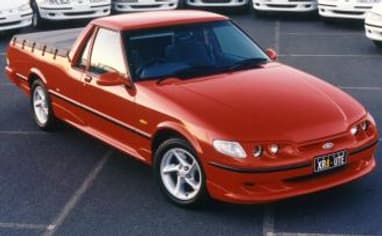
Ford Falcon 1998 Problems

Are you having problems with your 1998 Ford Falcon? Let our team of motoring experts keep you up to date with all of the latest 1998 Ford Falcon issues & faults. We have gathered all of the most frequently asked questions and problems relating to the 1998 Ford Falcon in one spot to help you decide if it's a smart buy.

Too hot for some
Answered by Graham Smith · 28 Oct 2004

YOU don't say how many kilometres your car has done. If it's done plenty it might simply be heavy wear that's causing a loss of oil pressure. Because you say it only happens on hot days, or when towing your caravan, it probably won't show up at other times, such as when you have it checked. Start by making sure all is well with the engine, spark, fuel, etc, and thoroughly check the cooling system to make sure all is well there. Change the coolant and use the recommended coolant, check the fan belt, water pump, and thermostat. If everything checks out you might think about an oil cooler.

Ford recall puzzle
Answered by CarsGuide team · 09 Sep 2004

THE recall, applying to AUI and AUII Falcons built between June 1, 1998, and May 22, 2001, relates to a steering rack mounting stud. Ford says over-tightening of the stud could cause the stud to loosen. In extreme cases, the stud may fail and affect steering. Two cases of loose studs and one case of a missing stud have been reported, but Ford is recalling all cars to take precautionary action. Vehicles built in the period outlined used a Loctite threadlocking compound, which could be degraded if the stud was over-tightened. Vehicles built after May 22, 2001, are not affected.

Falcon and on
Answered by Carsguide.com.au · 19 Aug 2004

IT'S GREAT to hear you've had a good run. I can't predict how much further it will go, but there's no reason it won't go for quite some time yet. Ford has a bogey of 10 years and 250,000km for their testing. After that, there will be some deterioration. A compression test may give insight into the condition of the engine, and explain the miss.

Falcon bad vibrations
Answered by Carsguide.com.au · 25 May 2006

I would have someone look at the fuel injectors, and think about having them cleaned. It could be a blocked or partly blocked injector, it sounds much like a problem I had a few months ago and that was fixed by cleaning the injectors.

Ford Falcon: Radiator replacement
Answered by Graham Smith · 14 Apr 2005

YOURS is not an unusual problem. The Falcon radiator has plastic tanks and they usually split, requiring replacement. Taxi operators usually run the heavy-duty radiator that doesn't have plastic tanks.

Has Ford converted to metric units?
Answered by Carsguide.com.au · 17 Apr 2003

The Falcon is now virtually 100 per cent metric. Ford switched over with the AU. The only A/F items are some seat and seat-belt mountings, and to change them would mean considerable expense in retesting to meet Australian Design Rules. And only qualified people with the appropriate tools should work on safety-related hardware.

Mystery leak
Answered by Carsguide.com.au · 16 Jan 2004

It's clearly a fuel leak so check all hose connections carefully for signs of leakage, and do it with the engine running so the system is under pressure. When you say you've replaced the purge tank, I assume that means the evaporative emissions canister to which fuel vapour is fed from the tank. If not, try changing that. Also, check the fuel cap to make sure it's sealing properly. And it's worth checking the dash to ensure all the seals are in place.

Used Ford Falcon AU review: 1998-2000
By Graham Smith · 22 Jan 2009
Ford launched the ill-fated AU Falcon with the slogan “You’ve come a long way baby” and proclaimed it as “dramatically different”. It was rather too dramatic for the conservative tastes of many Australians, and what was otherwise a decent car was crucified for its sad, down-in-the-mouth shape, but if you can put its depressing styling aside you’ll find a very competent family sedan that’s going for a song on the used car market.MODEL WATCHThe AU was doomed from the start when the motoring media jumped all over its radical styling. Some didn’t like the Forte’s waterfall grille, others the overuse of oval shapes, which was reminiscent of the imported Taurus, but most loathed the way it fell away at the corners, in particular the rear corners.It seems that there were plenty of Australians who agreed with the criticisms and either put off buying a new car and stuck to their older EF or EL Falcons or switched to a Commodore.While styling is a matter of individual taste, there were some practical criticisms of the AU’s shape. Headroom was limited, and it was easy to bang your head on the roof side rail as you got in or out of the front or rear. The shape of the rear door openings, and doors, was also criticised for the way it made it difficult to get in to the rear seat.AU’s interior also came in for some well deserved criticism. The extensive use of oval shapes and cheap looking plastics created a dash with a cheap and nasty appearance. Otherwise the Falcon’s interior was roomy and quite comfortable, although the aforementioned headroom problem was something taller drivers had to contend with.Power was predominantly from Ford’s venerable 4.0-litre overhead camshaft straight six that was more refined and smoother than before due to increased rigidity of the crankshaft, cross-bolted main bearing caps and a structural aluminium oil pan.Power from the base ‘Intech’ engine was 157 kW at 4900 rpm, while torque was 357 Nm at 3000 rpm, which gave it plenty of punch, and made it ideal for towing.For greater economy Ford offered a dual-fuel option, which allowed owners to take advantage of the lower price of LPG. While peak power of the LPG engine was down on the petrol version, the torque was the same; hence there wasn’t much loss of performance.Another neat feature of the AU was the fail-safe cooling which allowed you to limp home even if you lost all coolant from the system. The system simply shut down individual cylinders as needed to cut the running temperature of the engine.Naturally such a system required a level of reliability of things like the cylinder head gasket and Ford put a lot of work into improving it, which will be a great relief to Falcon owners who suffered head gasket failures on earlier models.The auto trans in the AU was more refined with smoother shifting, with claims that the service life would be as high as 250,000 km.The AU’s suspension promised improved comfort and handling, with revisions to the double wishbone front and Watts Link live axle rear. Independent rear suspension was available as an option.Forte was a new name to the Falcon range. The new badge, which has since disappeared in the BA, was fitted to the base model, while the familiar Futura and Fairmont badges were retained for the luxury and luxury sports models.IN THE SHOPContinuous development over many years has seen the Falcon evolve into a sturdy car that doesn’t have a lot of faults, at least major ones.Mechanics report few problems with the AU, there doesn’t appear to be the same issue with cylinder head gasket failure as there was in earlier models. A design revision on AU has cleaned up the problem pretty well, although further improvements to the head gasket in the new BA would tend to suggest that Ford didn’t think the problems were completely solved in AU.On the road, there is little to complain about, although the Falcon is not as economical as the Commodore, at least around town. Expect the Falcon six to use about 15-20 per cent more fuel in city usage, but there is little difference on the highway.WATCH FOR:• Sad styling has made the AU a laughing stock• Roomy interior ideal for transporting family• Robust and reliable with few faults• A little heavier on fuel than rivals
Read the article
Used Ford Falcon review: 1992-2000
By Graham Smith · 21 Oct 2003
Before the hot XR6 was unleashed in 1992, fast Fords were V8-powered. So the six-cylinder sports sedan came as a surprise to everyone. The XR6 was a bent-eight beater, but it was much more than that.  It was not only fast, it also handled beautifully and was comfortable.Had we known then what we later found out about Tickford, now called Ford Performance Vehicles, it wouldn't have been such a surprise.  The EBII XR6 was the first glimpse of Tickford's ability to produce a refined sporting sedan that did everything well.  It had often been the case with Aussie-built muscle cars that power was everything.That relentless pursuit often came at the cost of handling, ride and comfort, but Tickford brought a European approach which balanced power and road manners.  Another surprise came in the styling, which was neat and attractive, without being look-at-me in the way of most other muscle cars.  But if the XR6 was rather reserved in appearance terms, there was nothing reserved about it when it hit the road.THE XR6 was based on the EBII Falcon S, a sportier version of the family four-door sedan.  The engine was the Falcon 4.0-litre single-overhead cam unit, an effective but rather harsh and lumbering lump. But it had come under the spell of the engineers at Tickford Vehicle Engineering, Ford's performance partners who started working with the men from Broadmeadows in 1991.By the time Tickford was finished tinkering with the Falcon's head, cam, valves, valve springs, exhaust system and electronics, the fuel-injected six was slamming out a massive 161kW at 4600 revs and 366Nm at 3650 revs. And all of that while running on regular unleaded.It was enough to have the 1529kg sedan sprinting to 100km/h in 7.5sec. The standing 400m sprint was covered in 15.5sec and it had a top speed of 223km/h.They were numbers that had the V8 brigade looking back in horror, but they didn't tell the whole story, which was that the XR6 had plenty of low-end and mid-range punch which made it very driveable.Gearbox choices were a five-speed manual and a four-speed auto which delivered the power to the live axle LSD rear end running a low 3.45-ratio axle which helped it jump out of corners.Back in 1992 Ford was committed to a live rear axle, but Tickford's engineers managed to tame it quite effectively. The XR6 rode lower and had a package of gas shocks, stiffer springs, larger anti-roll bars front and rear which, coupled with revised front-end settings, made the steering precise and responsive and brought an assured balance to the handling.Despite still having 3.1 turns lock-to-lock, the Falcon could be pointed at corners with confidence it would hold its line right through to the exit. There was still some evidence of the roll oversteer associated with the Ford rear end, but it would quickly settle under power.To match the go power, the XR6 was equipped with decent disc brakes, which worked in tandem with ABS. The XR6's rolling stock consisted of 15-inch five-spoke alloy wheels and 205/65R15 Michelin tyres. It stood out from the Falcon crowd with body-coloured bumpers and mirrors, red rub strip inserts and a small rear wing.Inside there were reshaped sports front seats which were more supportive and comfortable than the regular Falcon ones. They had velour facings, were highlighted with red piping, and there was also a leather-trimmed Momo sports steering wheel and gear shift knob.ALL alloy-headed Falcon sixes have a problem with head gaskets. It's not unusual to blow them at any time, but they seem to be more prone to it from about 80,000km onwards.Cylinder head reco experts say there is a problem with coolant circulation, which leads to a steam pocket at the rear of the head which can then lead to gasket failure and cracking of the head.Some even relieve the problem by tapping into the head and allowing the coolant to flow from the problem area through an external pipe.  Suspension bushes can be a problem at higher mileage, and require replacement to restore the XR6's renowned handling.Falcon electrics can also be troublesome. Body control modules are a headache and replacements are expensive, so check the system's operation as thoroughly as you can.  Engine oil leaks are also a common problem. Look at the front cover and power steering pump.MARK Harris bought his white XR6 new in 1993 and has driven it sparingly. It has just 51,000km on the odometer and is driven only on weekends, when he enjoys it very much.  Dion Coughlan bought his three years ago when it had done 175,000km. He has added another 80,000km, and says he drives it hard.It has had a near-death experience when it was hit by a bus. Despite a few rattles, Dion says it still performs well. Apart from minor things such as a fan belt, the only things Dion has had to replace are the front suspension bushes.
Read the article
Disclaimer: You acknowledge and agree that all answers are provided as a general guide only and should not be relied upon as bespoke advice. Carsguide is not liable for the accuracy of any information provided in the answers.
Have a new question for the CarsGuide team?
More than 9,000 questions asked and answered.
Complete guide to Ford Falcon 1998
Complete guide to Ford Falcon 1998 CarsGuide Logo
Reviews, price, specs and more