









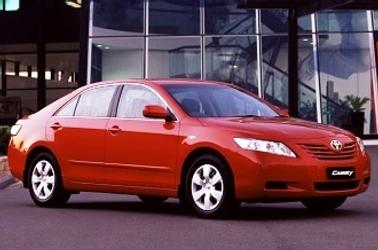
The Toyota Camry Hybrid is easy enough to spot in the Cow Hollow Motor Inn downstairs car park. But then that car park becomes a bit tricky when starting up, manoeuvring and moving off into the streets of San Francisco without the familiar accompanying sounds of a petrol engine.
The driver's OK, he's expecting this lack of noise once the start-stop button has been given a jab, there's a ready sign on the instrument cluster and the park brake warning sounds, indicating the sedan is ready to move.
No, here the problem is with pedestrians, travellers blithely wandering through the parking lot, people who do not understand the Camry (which looks like any other Camry apart from a couple of neat Hybrid badges) is on the move.

This happens with most hybrids of course, the silent travel around sprawling car parks, but it's brought into sharper focus when sitting on the left-hand side of the sedan and trying to figure out the quickest, least intricate route out of downtown San Francisco. There are grid systems here, it's just that at some stage a pair of grids intersect at far less than a 90 degree angle.
Then there are the trams and cable cars and a series of one-way streets. And don't forget the hills, steep and tough when the next intersection with a Stop sign is half way up Sacramento to Nob Hill. (For the Americans do have a sensible and polite method of controlling four-way, sometimes five-way intersections with Stop signs rather than traffic lights.) Setting off from one of these stops the Camry has a little judder, the electric motor maybe deciding if it needs help to get away.
This hesitation is sometimes felt at freeway speeds, where the Camry's been cruising quietly at 75mph (120km/h) and running electric before the need for more power to overtake yet another Prius. (On the West Coast, the Toyota Prius is everywhere, in May there were 24,009 Prius hybrids sold across the US compared with 21,780 Mercedes-Benz models.) The bigger brother Camry Hybrid comes with a 33kW electric motor, 110kW, 2.4 litre petrol engine and Constantly Variable Transmission. And for the most part, aside from those occasional judders under heavy load, it is a quiet and comfortable sedan, if not one for car chases through San Fran's streets.
The front end on this one was a touch doughy, and not as responsive at the steering wheel as Australian petrol Camrys. (Toyota Australia says there are no plans at present to bring the hybrid Camry Down Under.)
Whether the different feel was down to the Hybrids' steering and suspension or North American specifications, we're not sure.
Yet the electric-petrol-CVT powertrain and a soft front end did not stop this Camry Hybrid from a couple of free-spirited runs, one behind a pack of bikers on the twisting, turning Highway One north of San Francisco. And through all of this, climbing steep city streets, running with the pack down freeways and mixing it on country roads, the car returned just under nine litres per 100km. That's not bad for a fair-sized family sedan.
Luggage space is more limited than in a conventional Camry, but the car is a usable sedan not lacking any traditional attributes.
In the US, Toyota Motor Sales' advanced technologies manager Bill Reinert says changes in modern-day motoring, effectively to reduce the “footprint of mobility”, are coming. Los Angeles has slowed, almost stopped, and building freeways and the car culture among many young Americans is weakening.
“The emotional aspect is falling away. Cars are being treated more like an appliance,” he says.
Reinert says development of the current hybrid crop, and of electric vehicles, is being driven by a number of factors from long-term supply of oil to emissions and congestion.
“Eventually, we may want to rethink the whole concept of the personal car and how it fits in tomorrow's cities,” he says. “Cars using electric propulsion provided from batteries or fuel cells offer more than zero emissions, they also promise complete by-wire operation. With these advances, we could design a car that can drive sideways and automatically park in a parking space exactly the same size as the car.
“Eventually, we could double the parking capacity that currently exists in major cities.” (As long as we can hear those cars coming.)
Reinert says sustainable mobility needs a holistic approach; he understands a Prius Hybrid may not be the car for rural Texas, and that urban planning and mass transit systems have a part to play. But for now, cars such as Camry Hybrid are helping point the way.
Related cars for sale on CarsGuide
See more Toyota Camrys for sale View cars for saleToyota Camry 2010: Hybrid
| Engine Type | Inline 4, 2.4L |
|---|---|
| Fuel Type | Unleaded Petrol/Electric |
| Fuel Efficiency | 6.0L/100km (combined) |
| Seating | 5 |
| Price From | $6,820 - $9,570 |
| Safety Rating |
|


Pricing Guides
.jpg)
.jpg)
.jpg)
.jpg)
.jpg)
.jpg)
.png)
.jpg)
.png)
.jpg)
.jpg)

.png)
