







McLaren a Ferrari-killer


Philip King is a former CarsGuide contributor, and currently is Motoring Editor at The Australian newspaper. He is an automotive expert with decades of experience, and specialises in industry news.
Read full bio


CarsGuide puts every effort into ensuring the accuracy of the information it publishes. Double-check the details that matter to you before buying. Learn more about how we fact check.
The first time Formula One outfit McLaren designed and built a road car it set a high-water mark for performance that went unchallenged for years. The $US1 million F1 was the fastest production car you could buy and a must-have for any serious celebrity revhead from Jay Leno to Rowan Atkinson.
Just 106 were made, ending in the late 1990s, well below the production target of 300. But it won Le Mans at its first attempt and many of its records stood until they were blitzed by the Bugatti Veyron. McLaren boss Ron Dennis says the F1 is unique among recent supercars because they now change hands for huge sums, with one example going for $US5.5m ($5.35m).
"It's the only car that's been made in the last 30 years that's appreciated,'' he says on a recent visit to Australia. "I was very tempted to think, I've got all the old tooling, why don't I just knock out a few.'' But he didn't. Instead, McLaren decided to become a full-time carmaker competing with the Italian thoroughbreds and has spent almost pound stg. 800m ($1.26 billion) since 2005 setting itself up.
Shop Mercedes-Benz Cars
Search all carsEventually it will offer three models, all high-performance cars built in Britain at a shiny pound stg. 40m production facility. The goal is to make 4000 cars a year by 2015 -- Ferrari makes about 7000 -- for sale globally. McLaren has set up distribution in 18 countries and the first car, the MP4-12C, was launched almost a year ago in Britain.
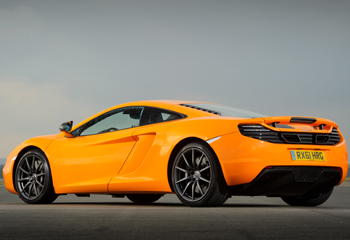
Australian distributor Trivett has just begun delivering the 12C and already has names against its allocation this year of 30. The MP4-12C is the middle car of the three planned. On price and performance it takes aim at the Ferrari 458 Italia, a $500,000, two-seat, mid-engined V8 supercar launched two years ago to critical acclaim.

Planning for the 12C began before the 458 was unveiled but Dennis believes the McLaren is more than its equal. "Our ability to predict what the competition was going to be proved relatively correct,'' he says. "We comfortably matched and exceeded it in every area. '' They make an interesting comparison. The 12C is powered by a 3.8-litre turbocharged V8 that develops 441kW, against 425kW for the Ferrari's naturally aspirated 4.5-litre V8.
The McLaren has more torque, 600Nm against 540Nm, and it arrives lower in the rev range. Despite turbocharging, the 12C engine revs to within 500rpm of the 458, to 8500rpm. They both send drive to the rear wheels via a seven-speed double-clutch transmission. The McLaren is marginally smaller and made mostly from carbon fibre where the Ferrari is aluminium.
The result is a 50kg weight advantage to the 12C. All that translates into a performance edge for the 12C that's borne out in all its vital statistics. It accelerates to 100km/h one-tenth of a second faster, in 3.3 seconds. Keep going to 200km/h and the 12C increases its lead, reaching the mark in 9.1 seconds -- 1.3 seconds quicker.
Subscribe to our newsletter
Stay up to date with the CarsGuide weekly newsletter
By subscribing you agree to our Privacy Policy.
It has a higher top speed and can lap the Nurburgring, the benchmark German testing track used by all performance cars worth the name, in 7 minutes 28 seconds, or about as fast as any production car and 10 seconds quicker than the Italian. It even decelerates more effectively with an active air brake that automatically deploys above 95km/h. From 100km/h it can stop in 30.5m compared with 32.5m for the Ferrari. The air brake doubles as a wing to increase downforce at the rear.
 McLaren also set out to make its car as efficient as possible. It claims the 12C has the lowest CO2 emissions per horsepower of any car in the world, including hybrids (with the single exception of a Mercedes fitted with idle-stop).
Those are a lot numbers to take in, but they translate into sensational performance (see First Drive opposite) and also something of a moral victory for the British outfit over its perennial Formula One rival.
Both say their road cars employ racing technology and on-track competition has been intense.
McLaren has achieved 176 wins since 1966, taking the chequered flag in one in every four GPs in which it has competed. Ferrari has 217 wins since 1950. But it's about more than just track performance, Dennis says.
The 12C had to "absolutely excel in the area in which its most used'' -- daily driving at legal speeds. It avoids the drawbacks of many supercars because it's quiet and comfortable when it needs to be. "Its active suspension is switchable between three modes with dramatic differences in the settings.
This is the best handling sportscar in the world. In ride and comfort there's nothing that surpasses it. If you're on a track, it's an out-and-out race car. If you drive it on the road it's smooth like a Rolls-Royce.'' The 12C has visual echoes of the original F1 and many engineering similarities, such as its carbon fibre construction and mid-engined layout.
But the aim was never to replicate the F1, with its unorthodox central driving position with two passenger seats behind. And buyer expectations have moved on. "No one would buy that car (the F1) today and be happy with it, apart from pure performance,'' he says. "It's too raw, too aggressive, too firm.''
McLAREN MP4-12C
Vehicle: Supercar
Engine: 3.8-litre turbocharged V8 petrol
Outputs: 441kW at 7000rpm and 600Nm at 3000rpm
Transmission: Seven-speed double-clutch automatic, rear-wheel-drive
Price: $493,100 plus on-road costs
On Sale: Now
Why you should trust us




Read More


.jpg)
.jpg)
Contributing Journalist
Philip King is a former CarsGuide contributor, and currently is Motoring Editor at The Australian newspaper. He is an automotive expert with decades of experience, and specialises in industry news.
About PhilipNews & reviews
-
![]()
Renault Symbioz 2026 review: Techno mild hybrid | Nissan Qashqai rival tested
Laura Berry 25 Sep 2026 1 Comment
 -
![]()
Porsche Cayenne S Electric 2026 review: snapshot | Volvo EX90 rival tested
Stephen Ottley 25 Sep 2026
-
![]()
From the 2026 Hyundai Palisade to the Veloster and Inster, here's why Australia is one of Hyundai’s most important markets
Tom White 25 Sep 20261 Comment -
![]()
2027 Wuling Eksion 560 approved for sale in Australia as affordable alternative to 2026 Tesla Model Y and Zeekr 7X electric mid-size SUVs
Tim Gibson 25 Sep 20261 Comment -
![]()
Leapmotor responds to Dahua camera security controversy in Australia, involving 2026 Leapmotor C10, B10 and B05
Tim Gibson 25 Sep 2026 -
![]()
2027 Nissan Pixo strikes back against BYD Atto 1 and GAC Aion UT as budget-focused city car
Chris Thompson 24 Sep 20262 Comments -
![]()
Ram 2500 2026 review: Warlock – Australian first drive | Chevrolet Silverado rival tested
David Morley 24 Sep 2026
-
![]()
2032 Honda Pilot XXL could be new hybrid family SUV to potentially rival 2026 Hyundai Palisade and Toyota Kluger in Australia
Tim Gibson 24 Sep 20261 Comment


