









New vehicles are awarded or deducted points based on a combination of test categories and scientific criteria. All vehicles are assessed under identical testing’s standards and conditions.
In all tests, dummies are used to measure the various forces on the occupants in a crash. The data gathered is then assessed, using internationally recognized protocols and star-ratings are determined for each crash test.
 Observations are also made on the displacement of dummies during the crash, as well as the structural impact on the vehicle's occupant compartment.

Points are also awarded if the vehicle is fitted with safety features such as Anti-lock Braking System (ABS) Electronic Stability Control (ESC) and seat belt reminders.
To achieve an ANCAP 5 Star rating, a vehicle must achieve the highest international recognized standards in all test categories.
The more stars, the better.
Occupants have twice the chance of being killed or seriously injured in an ANCAP 1 Star rated vehicle compared to an ANCAP 5 Star rated vehicle.
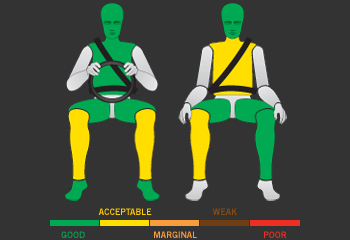
The diagrams below show typical injuries to the drive and passenger for each ANCAP Star rating in Frontal Offset Testing, conducted at 64 km/h.
In interpreting the colour results on the dummy diagrams for each star rating, it is important to note that a red and brown result (Poor & Weak respectively) on any limb or part of the body indicates that there is a high risk of serious injury or death resulting from that injury alone. Consumers should therefore not assume that an injury to the foot area - shown as red in both ANCAP 1 and 2 star rated vehicles - is necessarily less serious, or less life threatening, than the same crash result in other parts of the body.
For more information on star ratings, visit the ANCAP website.


.jpg)


