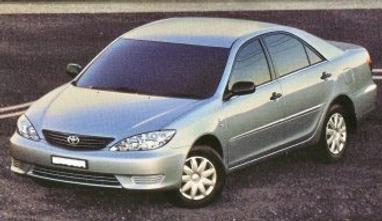
Used Toyota Camry review: 2002-2006
By Graham Smith · 14 Jul 2009
The Camry has often been the subject of derision and scorn, rarely has it been an object of desire. It has come to be the car we know deep down we should own, but could never bring ourselves to buy. Toyota has built an enviable reputation, and market leadership, on the back of the reliability and durability of its cars, but those things alone are not enough to entice buyers into dealerships. For anyone with petrol running through his or her veins it also takes a healthy measure of emotion, something Toyota generally lacks. The Camry has reliability and durability in bucket loads, but there’s not a lot about it that gets the juices flowing. It’s the safe bet, one you probably won’t regret, but it’s not the car you want to talk about when standing around the barbie. The wide-bodied Camry was a popular car in the 1990s, but did little to endear the badge to buyers looking for a car they could brag about. It was a frumpy four-door, one you parked out of sight rather than in your driveway. It seems that Toyota got the message as the 20th century steamed to an end and began to take more interest in styling.Perhaps there was a realization that they had to appeal to a broader range of buyers if they were to conquer the world as they hoped to do. Whatever the reason, today’s Camrys are much more attractive, with bold flowing lines and nicely balanced proportions. The Series 30 Camry was launched in 2002 and brought with it a tighter look with well-defined lines and an aggressive front end that included wildly sweeping headlights. It was a bold statement from the company that tended to lurk out of sight in the shadows when it came to automotive styling. The Camry’s power choices were a new locally-produced 2.4-litre double overhead camshaft four that was packed with plenty of technology, like Toyota’s VVTi variable valve timing system that gave it smooth pulling power right through the rev range. When stretched to the limit it would produce 112 kW at 5600 revs and 218 Nm at 4000 revs. The alternative was a 3.0-litre double overhead camshaft V6 that produced 141 kW at 5200 revs and 279 Nm at 4000 revs. While most Camrys would have left showrooms with the four-speed auto in the tunnel, it was also possible to have a five-speed manual gearbox. Underneath, the suspension wasn’t earth shatteringly new, with struts front and rear, but worked very well. Local tuning by Toyota’s engineers ensured it handled our roads well; with admirable ride comfort and reassuring handling even over rough surfaces. Likewise, the power steering was well weighted and accurate, and the brakes, a combination of ventilated front discs and solid rears, with ABS oversighting the action, were positive and powerful. There’s plenty of room inside the Camry for a family of five, it’s well equipped and comfortable. The Camry does duty in the toughest arenas, the non-caring world of the fleet car and the school and supermarket runs of mum and the kids, so look for collateral damage from the bump and run of daily life. Bumps and scrapes on body extremities are commonplace, it’s part of the Camry’s natural environment. Nothing looks worse than body scaring and it’s costly to repair. They also tell a tale of how well the car has been treated. If it’s scarred on the outside there’s a good chance it’s scarred on the inside. Check for a service record and make sure the engine oil has been regularly changed. There’s nothing nicer for an engine than fresh oil, sludge build-up is the engine’s natural enemy. The four-cylinder Camry engine has a timing chain so there’s no servicing required until it starts to rattle, but that won’t happen until way into the upper reaches of the odometer. The V6 does have a belt that requires changing at around 150,000 km. Build quality is high, all parts fit together well and stay together over the life of the car, so you don’t tend to find things fall apart or off the Camry in service. The capable chassis with precise steering and powerful brakes presented a convincing primary safety argument for the Camry, and with dual front airbags, plus side airbags there was plenty of protection when the metal started crumpling. Size hampers the Camry when it comes to pump performance. The four-cylinder cars will do 10-11 L/100 km around town and a little better on the highway, while the V6 models will consume on average 1.5 litres more. Ron Flint bought his 2005 Camry in 2007. He had hired a Camry while on holiday and was so impressed with its performance, economy, easy handling and features that he bought one when he got back home. The Camry had done 5000 km when he bought it to replace his 200,000 km Falcon, which had blown a head gasket. Eric Deakin bought his 2005 Camry Ateva V6 seven months ago having done 97,000 km, and reckons it’s the best car he has owned in more than 60 years of motoring. He says it is a well-built, well-appointed and very roomy car, which has excellent performance. So far he has found no faults at all with it and would happily recommend it to anyone. Rex Manuel bought his 2003 Camry Ateva four-cylinder second hand in 2005. He is happy with the Camry’s roominess and its generous boot, but misses the performance of the Ford Fairmont he owned previously. • Sharp looks. • Reliable mechanical package • Good performance • Smooth drivability • Good resale value Well-engineered, well-built, the Camry is robust and reliable, great transport for families.