What's the difference?
The Renault Master range has been refreshed, and this was our first chance to see what changes have been made.
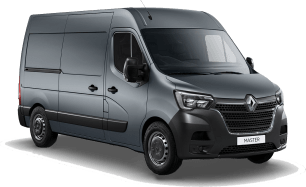
You should be able to tell just by the look of the 2020 Master that there’s a new design with a more modern looking front-end. And the inside has been thoroughly modernised, too.
But with contemporary rivals such as the VW Crafter and Mercedes-Benz Sprinter - both of which launched in all-new generation guises in 2018 - the question is whether the ageing, yet facelifted Master is worthy of consideration.
We spent a week with it - and covered plenty of kays in it - to find out.
Jeep's Renegade might be late to the mini-SUV party but it comes with a pretty impressive back catalogue to suggest that this is a SUV that can cash the cheques its name can write.
The top of the range Trailhawk can write even bigger cheques than the lower models, bringing with it a range of off-road tech toys to let you really get down and dirty.
If you’re after a budget-conscious offering in the large van segment, the Renault Master could be a really solid proposition. It falls short of the safety expectations set by its newer rival, though, and that’s something you might not be able to put a price on.
Rugged, dependable and good off-road are the most obvious qualities of the Trailhawk. It stands out from the rest of the mini-SUVs by being able to do the S and the U with plenty of vigour.
It's just a shame that its on-road manners can't match that of its big brother, the Cherokee. Unless you're planning on proper off-roading, the Trailhawk might not be quite what you're looking for.
The front-end styling of the Master has been modernised with a “robust” new look which sees it adopt a more upright nose with a bulkier grille, squared-off headlights (with LED daytime running lights as standard, along with halogen headlights).
There were no other changes made to the exterior, so if you see it side on or from the rear, you’d be hard pressed to tell if it's the new model.
This is the second facelift for this generation (X62) Master, which originated back in 2010. It is also offered in some markets as a Nissan, Opel, and Vauxhall. And this version certainly freshens up the appearance, though the practicality of the Master line-up remains unchanged.
That’s a good thing: you can still get the van as a short-wheelbase with low roof (L1H1), a mid-wheelbase with mid roof (L2H2), a long-wheelbase with mid roof (L3H2), or an extra-long-wheelbase with high roof (L4H3). There’s also the choice of a single cab-chassis Platform ute model, too.
Our test model is the L2H2, meaning dimensions of 5575mm long on a lengthy 3682mm wheelbase (giving it a 13.6-metre turning circle), while the width is 2070mm and the height is 2499mm. Too tall for car parks (and drive-thru windows, in this age of social distancing).
The good news about the height, though, is that it allows you excellent interior dimensions. The cargo hold of this version is 3083mm long, 1765mm wide (and 1380mm between the wheel-arches, enough for Aussie pallets to slide in easily), and the height is 1894mm inside. I’m six-foot tall (1820mm) and that meant I could safely step in and out of the cargo zone without fear of hitting my head. The load space is 10.8 cubic metres in this spec.
As you’ll see in the interior section, the cabin has been given a bit of attention too - you can see it in the images below.
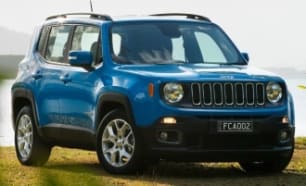
In what is absolutely not a coincidence, the Renegade immediately conjures up the Wrangler. Upright grille from the Willys Jeep (references abound here), round headlights, squared off wheel arches to mimic the Wrangler's guards, short overhangs and big rear view mirrors.
The 17-inch wheels look completely lost in the wheelarches which are even more cavernous owing to the Trailhawk's 50mm of extra ride height. The wheels are also a bit cheap looking but will probably survive the belting the car is intended to take.
Less rugged is the interior, despite a fairly self-conscious effort to make it look and feel chunky. The front seats are flat and unsupportive with the rears just as lacklustre making sure everyone is sliding around together. Luckily, front passengers get a dash-mounted grab handle.
It seems quite well put together, however, but with carpets and easily-marked plastics, you'll hope your passengers don't bring the mud in with them too often. And the "Since 1941" stamped into the steering wheel can go.
The dashboard is reasonably clear and has plenty of information to share via the screen between the dials but whoever thought marking the redline with a water splash graphic in bright orange should probably rethink their design decisions.
Storage is limited to two cupholders up front, door pockets in each door and nets on the front seat backs.
The 2020 update for the Renault Master saw prices adjusted to compensate for additional standard equipment now offered range wide.
You can read the full pricing and specs breakdown story here, but the standard goodies for the Master include: a new 7.0-inch touchscreen media system with USB input, Bluetooth, Apple CarPlay, Android Auto, sat nav and reversing camera display, a two-speaker sound system, rear parking sensors, 16-inch steel wheels with a full size spare fitted under the rear body, body-protective cladding, twin-view side mirrors with electric adjustment, electric windows, cruise control, air conditioning, remote central locking, halogen headlights, LED daytime running lights, and rear fog lights.
The list price for the L2H2 mid-wheelbase manual model used in this review is $47,490 plus on-road costs (RRP or MSRP), but Renault is advertising this exact spec for $47,990 drive-away, which is pretty compelling - you don’t even need to be an ABN holder for that discount.
The Master MWB van comes as standard with barn doors at the rear (270-degree opening), and a sliding side door on kerb side (left), while SWB models get 180-degree barn doors. It also features a steel bulkhead as standard, as well as a three-seat layout up front. There’s a handy lift-up base on the bench part of the seat, which allows you about 100 litres of hidden storage if you need it.
There are numerous options for buyers to customise their van to suit what they need. There are several packs to choose from, such as: the Trade Pack - wooden floor, full height timber wall lining, rear step, LED ceiling lights ($1600); the Business Pack - front fog lights, hands-free key card and push-button start, chrome exterior and interior trim finishes ($1000); and the Convenience Pack - auto high/low beam lights, lane departure warning, blind spot monitoring and front parking sensors ($1000).
You can option individual elements such as a driver’s side sliding door ($800), a driver’s suspension seat ($800 - removes the side airbag for the driver), a single passenger seat ($200 - N/A with driver suspension seat, adds passenger-side airbag protection), and if you choose RWD model there’s an available differential lock ($1000). Last but not least, you can have glazed dual sliding doors for $800, but only if you also option the Trade Pack.
Colour options include no-cost solid paint finishes in white, grey, dark blue, light blue, yellow, orange and red (the interesting colours will need to be pre-ordered). There are also three metallic paint options in grey, black or a silver/blue look, and the cost there is $1000.
The Renegade range starts at $28,000 for the 1.6-litre Renegade Sport manual front-wheel drive, climbing between $2000 and $3000 through the Sport Auto, Longitude Auto, Limited Auto with a final jump of $4000 to the 2.4-litre auto-only Trailhawk.
Standard is a nine-speaker stereo with Bluetooth and USB, 17-inch alloys, dual-zone climate control, reversing camera, rear parking sensors, keyless entry and start, cruise control, electric front seats with heating, satellite navigation, automatic bi-xenon headlights, auto wipers, leather trim, roof rails, front and middle bash plates, full size spare, heated leather steering wheel, privacy glass, trailer sway control and tyre pressure monitoring.
The lairy Omaha orange is $500, part of an eleven colour palette with only two no-cost paint options (black and white).
You can add lane departure warning, auto-parking and a black painted roof for $500 each, a removable and retractable roof called My Sky Roof for $2200 or a more conventional electric sunroof for $1900.
The Beats-branded nine-speaker stereo is run via Fiat-Chryser's UConnect system, accessible through the 6.5-inch touchscreen. While it improves with every attempt, it's still quite clunky and when the sat-nav is added, becomes a bit of a mess.
Thankfully, not every function has been crammed into the touchscreen interface, so you'll spend more time with your hands on the wheel rather than working out which bit of the screen has the climate control.
The power outputs and torque figures depend on the transmission you choose.
Despite the fact that both manual and automatic versions of the Master run a 2.3-litre four-cylinder diesel engine, there’s a difference between the engines: the version with the six-speed manual transmission is a twin-turbo unit, while the six-speed automated manual transmission makes use of a single-turbo diesel.
There’s not much in it when it comes to the difference in outputs, however.
The manual version has a slight horsepower advantage, with 120kW of power (at 3500rpm) and 360Nm of torque (at 1500rpm).
The automated manual has a maximum power of 110kW (at 3500rpm) and 350Nm of torque (at 1500rpm).
Both transmissions are geared the same across all six ratios, though from experience, the automated manual is best left at the showroom. While rivals offer conventional torque converter automatic gearboxes to appeal to a broader customer base globally, the French brand persists with its pernickety somewhat-auto option instead.
The majority of models in the Master range are front-wheel drive (FWD), but there are a couple of long-wheelbase rear-wheel drive (RWD) models available. None are all-wheel drive (AWD) or four-wheel drive (4WD).
You might be interested to note the weight specs for the Master range. There are too many variables to bore you with here, but the details on the L2H2 mid-wheelbase manual I tested, according to Renault Australia, are as follows: kerb weight - 1887kg; gross vehicle mass/GVM - 3510kg; payload - 1623kg; towing capacity - 750kg un-braked, 2500kg braked. The gross combination mass (GCM) is 6000kg.
The Trailhawk is powered by Fiat's 2.4-litre four naturally-aspirated four-cylinder producing 129 kW and 230 Nm. Jeep reckons you'll get 7.5L/100km on the combined cycle. Our mostly city driving with a longish motorway run produced an 11.0L/100km average over a week.
The transmission is a nine-speed ZF automatic driving all four wheels.
The Trailhawk also has Jeep's five mode Selec-Terrain system which should cover pretty much every eventuality – Auto, Sport, Mud, Sand and, just for the Trailhawk, Rock. The Trailhawk is rated to tow 400kg unbraked and 907kg braked.
I did a mix of driving in the Master over the week I had it, including more than 600km of unladen driving.
Why so many kays? I used it to move house, which meant I completed two “full” trips between Sydney’s inner-west and Cowra in the Central West of NSW, and two “empty” trips back to Sydney, as well.
I’ll get to how it drove with a load on board in the section below, but the unladen experience was pretty positive.
The engine and transmission are well teamed, and there’s a good amount of usable torque and very little lag to speak of.
As with this entire generation of engines - a derivative engine in a different state of tune is used in the Nissan Navara - the refinement is mostly good until you reach higher in the rev range, where it can get a bit noisy and clattery. But the best work is done down low in the rev zone anyway.
The manual shift action isn’t what I’d call “slinky”, more “clicky”. But it’s easy to row between gears as the action is light and the clutch isn’t too heavy, either. The gearing is generous, meaning you can saunter in sixth gear around 70km/h without the engine labouring too hard, and it’ll accelerate from there to freeway pace - provided you’re not going uphill.
There is a bit of ratio management required if you encounter a steep incline, but generally it’s a decently strong powertrain for its intended use - more on that below.
I’m always astounded about the steering and ride characteristics of vans of this size. Yes, it’s large, and yes, it can get blown around a little by crosswinds, and yes, you need to factor in the longish-wheelbase and larger turning circle that results from that… but it drives a lot smaller than it is.
The steering is direct and accurate, easy to judge at high or low speeds - which is great news when you’re parking (and there’s a good quality reversing camera and rear parking sensors, but you’ve just gotta remember the roof height, too).
The ride is adequate without a load on board, too. The independent McPherson strut front suspension copes well with changes in surface and bump control, though it can be a little bouncy at times. The rear suspension is a leaf-spring torsion beam setup, and it can be a little clumsy over road joins when unladen.
It also brakes well, with solid and trustworthy response from the four-wheel disc brakes at all speeds.
The Trailhawk name suggest that things are going to get muddy – compared to the rest of the range, the range-topper rides 50mm higher and has exposed, easy-to-reach tow hooks in the fairly unlikely event you get stuck. It also has a 20:1 low-range crawl ratio and Active Drive 4x4 which means it can switch between front and all-wheel drive. It'll also wade through almost half a metre of water. It's a genuine mud-plugging proposition and will take on some much bigger machinery out in the bush.
On the road, where we spent all our time in the Renegade, it's not what you'd call particularly inspiring. There's a number of sources of noise that contribute to a less than quiet cabin and having to constantly correct your course at freeway speeds adds to the tiring nature of the Renegade.
It's much better at lower speeds, pottering around but then again, its nine-speed transmission needs a lot more work on the shift mapping because it seems to forget which gear it needs to be in when you sink the right foot. If you don't need the Trailhawk's extra off-road goodies, consider the 1.4 litre Limited or Longitude.
While there has been a safety revolution in the van segment in recent years led by Mercedes and VW, Renault has been left behind to a degree.
The Renault Master has never been put through NCAP or ANCAP crash testing. So there’s no safety star rating to speak of.
And it falls short of its chief rivals, as it doesn’t have any sort of auto emergency braking (AEB) or forward collision warning system at all.
It has a reversing camera and rear parking sensors, plus dual front airbags and driver’s side airbag protection (not passenger though?), and there are no curtain airbags either. But it has electronic stability control (ESC), electronic brake force distribution, and hill start assist with Renault’s Grip X-tend system that is designed to allow better traction in slippery situations.
You can option some safety technology into the manual versions of the Master, by way of the Convenience Pack. For $1000 it adds auto high/low beam lights, lane departure warning (not active lane keeping assist), blind spot warning (not rear cross-traffic alert), and front parking sensors.
I understand the argument that buyers shouldn’t have to pay for anything they don’t need, especially when it comes to business vehicles. But I hope that behind closed doors Renault is working furiously to improve the safety equipment offering as a matter of priority.
Seven airbags (including driver's knee bag), traction and stability controls, roll mitigation, blind spot monitoring, ABS and brake assist.
The Renegade does not yet have an ANCAP star rating although it scored five EuroNCAP stars in 2014.