What's the difference?
SUVs are so ridiculously popular right now that nearly all carmakers have one, and if they don't they're scrambling to work out how to build one.
That's good news if you're looking to buy one because there's a sea of SUVs to choose from, particularly small ones, but it's also easy to get swamped by the choice.
So, just stop for a second – wouldn't it make sense to also check out an SUV from a brand that not only made the first SUV, but has only ever made SUVs? No, not Range Rover... Jeep.
The new Jeep Compass is a small SUV along the same price and size lines as the Mitsubishi Eclipse Cross or Nissan Qashqai. What Jeep was keen to impress on us at its launch was that the top two specs – the Limited and the Trailhawk – were quite capable off-roaders. That is an ambitious statement, and for something to have any off-road ability in this small SUV class is rarer then teeth on a hen.
We went to the wilds of Tasmania to drive these two. The mission: Are they really any good – off and on the road?
Jeeps have some of the best names in the car business. There’s the Gladiator, Renegade, and the Wrangler. Then there’s the Compass Night Eagle which is what this review is on. Night Eagle is the name of the grade, and it sounds terrifying.
Yup, they’re all great outdoorsy names that suggest these are tough go-anywhere vehicles with adventurous and brave owners who build fires, pitch tents and eat the elk they hunted with a bow that morning.
So, how does a Jeep Compass Night Eagle handle an urban jungle, full of tight streets, shopping centre carparks and school runs? It was also driven by me – and I'm someone who thinks ordering a double-shot cappuccino is adventurous.
The mission was to find out if the Compass – specifically the Limited and Trailhawk – was any good on or off the road. The answer is these two are excellent. Excellent for light-duty off-road terrain, but also good performers on the tarmac. It is disappointing that AEB is not standard even on these top-spec grades and if it was my money the optional safety gear would be the first thing I'd add before anything else.
Practical, spacious, and easy to drive it's great to see an SUV where the U for utility really means something.
The sweet spot in this range would be the Longitude for value, but if you're choosing a Compass give good consideration to the Limited - it has four-wheel drive, plus the bigger screen.
The Jeep Compass Night Eagle is good looking and offers great practicality for a small SUV, and comes standard with good city-focussed safety tech.
What stops the compass Night Eagle from being a great urban car is its thirsty petrol engine and a driving experience which isn’t all that enjoyable.
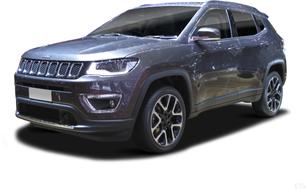
There are too many cute SUVs on this planet, which is why Jeep's unapologetically tough exterior styling is always welcome in my books. The Compass is more a mini Grand Cherokee than the Cherokee, with a high, broad and flat bonnet, squared-off headlights, signature seven-slot grille, bulky, strong wheel arches and the rear spoiler. This is a darned good looking SUV. The Trailhawk with its tough body kit gives the Compass an even more hardcore presence.
American cars tend to have less refined cabins than European and Japanese cars, but the Compass's interior has a premium feel. That said, we were only given the top-spec Limited and Trailhawk to drive, with their leather seats, large screens and all the fancy trimmings.
The Compass's dimensions are interesting because at 4394mm end-to-end and 1819mm wide, it's a big-small SUV like the Mitsubishi Eclipse Cross and Nissan Qashqai.
The height varies from the Sport and Longitude, which are 1629mm tall, to the 1644mm Limited and the Trailhawk at 1657mm.
The Compass also has small design elements you'll adore or abhor. They the 'Easter egg' surprises Jeep loves so much – tiny design features hiding around the car. I'm a fairly cynical bloke but even I liked discovering the lizard, the Loch Ness Monster, the Morse Code and the Willy's Jeep grille hidden around the car.
There aren’t many boring looking Jeeps. If anything they look like full-scale sand pit toys. The Jeep Compass is no different but has a more refined and domesticated appearance than a Wrangler. If anything, it looks like a mini version of the big Jeep Grand Cherokee with its low narrow grille, squared headlights and tall, flat bonnet.
Even the side profile of the Compass and the rear of the car with its tailgate and taillight design is shrunken Grand Cherokee looking. Which is odd because the Cherokee, which is bigger than the Compass, looks nothing like the Grand Cherokee.
Talking of size, how big is the Compass? Here are the dimensions. The compass is 4394mm long, 1819mm wide and 1629mm tall.
That makes it a small SUV, but not as small as the Jeep Renegade, which looks tiny enough to pick up and carry.
Night Eagle sounds like a special ops code name and there are some stealthy elements to the styling, such as the black alloy wheels and the blacked-out grille. These touches are a good combination with the Grey Magnesio paint my car wore. That’s a premium colour costing $645, but the black roof is standard. In the photos I took, the Night Eagle looks as dark and as brooding as the day I took these pictures.
I’ll talk about how much room is inside in the practicality section below, but for now I can tell you that the Compass’s interior has a layout which is more functional and rugged than refined and fancy. I wasn’t overwhelmed by the feel of the plastics, which to me didn’t have the same quality as interior elements of a Mazda CX-30 or Kia Seltos.
It's been a long time since I've squealed with delight (in a car), but until I pulled the little tab on the Trailhawk's front passenger seat, I had no idea its base folded forward to reveal a huge storage compartment underneath.
Under-seat storage space is rare, and while the entry-level Sport doesn't have the secret stowaway compartment every Compass has a decent sized centre console bin, two cupholders up front and another two in the back, plus bottle holders in all the doors.
A boot with a cargo capacity of 438 litres makes it one of the biggest in the class, although it can't quite beat the Mitsubishi Eclipse Cross's which can go from a luggage capacity of 341 to 448 litres thanks to a sliding rear row – no such thing with the Compass. Still you won't find many small SUVs with boot space dimensions this generous. The Compass's cargo cover (liner) is the no-retractable type.
How many seats in a Jeep Compass? There's seaitng for five and the room is excellent with a spacious cockpit for the pilot and whoever called shotgun, while rear legroom for me was great with about 40mm of space between my knees and the seat back which was in my driving position (no easy feat with me being 191cm tall).
Headroom is good, too – even with the optional sunroof fitted to the Limited and Trailhawk I tested.
I also liked the chunky, tough-looking, all-weather (standard) floor mats in the Trailhawk.
Good practicality in a small urban car means a cleverly designed interior, which makes the most of the limited space and the Compass hits the nail on the head here. There’s a storage space under the cushion of the front passenger seat (see the images), a deep centre console bin, decent-sized door pockets and four cup holders.
You’ll find two USB ports (one in the front and one in the back), along with a 12V outlet and a 230V power point.
Boot space is large for the class at 438 litres.
As for people space there’s plenty of elbow-, head and shoulder room up front, while legroom in the back is excellent and, at 191cm tall, I can sit behind my driving position with about 4cm between my knees and the seatback.
It's great to see that there are directional air vents in the second row.
Want to get into a Jeep Compass model for as little money as possible? Go the Sport grade, which lists for $28,850 and you'll also instantly become more attractive because it has a manual gearbox. Can't shift on your own? Don't stress there's an automatic, but you'll pay another $1900 for the privilege. Just to be clear the Sport is not a Sport edition - there really is no sportier slant here compared to the rest of the range.
Standard features at the Sport level are fairly ordinary but, no, Jeep hasn't been stingy. There's a 5.0-inch touchscreen, reversing camera, six-speaker stereo with digital radio and Bluetooth connectivity, leather wrapped steering wheel, keyless entry, air conditioning, cruise control (not the adaptive type), daytime running lights, and 17-inch alloy wheels.
Want more? There's the Longitude, which would come close to being the best value in the range but further up the price list at $33,750, and comes with all the standard features of the Sport grade but adds auto headlights and wipers, roof rails, tinted rear glass and passenger seat storage.
Yup, a 5.0-inch screen is small, so if size matters to you, you'll be impressed by the 8.4-inch display in the $41,250 petrol version of the Limited.
This grade also comes with a massive haul of standard feature such as sat nav (GPS navigation system), Apple Carplay and Android Auto for iPhone and Android users, nine-speaker Beats Audio sound system with digital radio, dual-zone climate control, heated front seats (but no heated steering wheel), leather-wrapped steering wheel, auto headlights and wipers, roof rack, tinted rear glass, auto parking (park assist for parallel and perpendicular parking), passenger seat storage and 18-inch alloys. Want diesel with that? Then you'll pay another $2500.
The Trailhawk sits at the top of the range at $44,750 but misses out on some of the Limited's standard features. This might seem like some type of scam, but it isn't because while it doesn't get a proximity key, push button start and the fancy stereo, it comes with off-road components such as red recovery hooks and under-body protection, there's also different 18-inch rims to the Limited.
I'm not a fan of the reversing camera picture quality. I can tell the screen is excellent from the clarity of the maps in navigation, but the camera itself must be letting things down with not capturing the best quality image. Not a deal breaker, though.
The Compass comes with two USB ports and two 12-volt outlets (one of each in the front and in the back), while the Limited and Trailhawk also come with a 230-volt outlet.
A power tailgate can be optioned on the Limited and Trailhawk through the purchase of a $2450 tech pack. A panoramic sunroof is $1950, and if you like the two-tone black roof that'll be $495 please.
The sport and Longitude come with halogen headlights, while the Limited and Trailhawk get bi-Xenon. There are no LED headlights in the Compass range, sadly.
All come with hill assist, but only the Trailhawk has hill descent control. I know what you're thinking - no CD player. Yes, outrageous.
Only the 'Colorado Red' colour is the standard paint, the rest are optional and includes 'Minimal Grey' which is really silver, 'Brilliant Black', 'Vocal White', 'Hydro Blue', 'Grey Magnesio', 'Mojave Sand' and 'Bronze Metallic' a sort of orange or as I like to call it Electric Brown. No yellow or army green unfortuantely. How cool would a Trailhawk look in a matte green? That would be special.
The genuine accessories list isn't huge for the Compass and doesn't list a bullbar, nudge bar or a snorkle - it would be best to speak to Jeep before fitting these through another provider.
What other SUVs would you compare the Compass to? Well, as a model comparison the Mitsubishi Eclipse Cross matches the price and size, while the Nissan Qashqai would be another rival. That said if it was Qashqai vs Compass off the road - the Jeep would win hands down.
The Night Eagle is the entry point into the Jeep Compass range and lists for $36,950.
The standard features lists has what you’d expect to find, such as an 8.4-inch screen with Apple CarPlay and Android Auto, cloth seats, roof rails, 18-inch alloy wheels and auto headlights (halogen). There are also a few features which you don’t always see on entry grades, such as sat nav, tinted windows, dual-zone climate control and LED taillights.
There’s no proximity key or push-button start, nor is there a wireless charger, nor front parking sensors. Those are a few items that make the short trips and constant in-and-out use of an urban car easier.
The Compass is available with a 2.4-litre 129kW/229Nm four-cylinder petrol engine or a 2.0-litre 125kW/350Nm turbo-diesel. Yup, the diesel motor is smaller in engine size but that turbo makes up for it, while the petrol feels like it needs more horsepower. Those are fairly simple specifications to get your head around, which is good.
The catch is the Sport and Longitude only come with the petrol engine, in front-wheel drive (FWD) (4x2) with a six-speed auto or six-speed manual offered on the Sport, and auto only for the Longitude. There's no rear wheel drive only Compass.
The Limited comes with a choice of the petrol or diesel, with four-wheel drive (4WD) (4x4 or 4 wheel drive, which is different to most all wheel drive systems) and a nine-speed automatic transmission.
Jeep does not recommend towing in the front-wheel drive petrol variants, while it advises the braked towing capacity of the 4x4 petrol Limited is 1000kg and 1500kg if you're in the Trailhawk. That's not terrific pulling capacity, but remember this is a small SUV. A tow bar kit is available through Jeep's accessories department.
During test we didn't experience any automatic transmisison problems or general transmission issues.
Gross vehicle weigh ranges from 1905kg for the Sport to 2189kg for the Trailhawk.
The Trailhawk is diesel only, which is the better engine, with its higher torque all rushing in as low down as 1750rpm (idle is about 800rpm). The petrol isn't bad, it's just not as grunty.
Thank the auto gods that Jeep hasn't chosen a CVT auto. The nine-speed auto is great – quick and smooth, although, with so many gears, it can sometimes feel indecisive about where to shift next.
The Night Eagle is the only front-wheel drive variant in the Compass range, although it has the same 2.4-litre petrol engine as the all-wheel drive Limited and S-Limited grades. In Jeep World even the engines have cool names and this one is called the Tigershark.
If only the engine was a good as its name because with 129kW and 229Nm I felt that, in the Compass, this four-cylinder engine was underpowered even when unladen.
A six-speed automatic does a good job of smooth shifting, however.
Quite a lot or not much depending on which engine you choose. The petrol is the thirstier one, and when teamed up with the six-speed manual in the FWD Sport is claimed to consume 8.6L/100km over a combination of urban and open roads, while the six-speed auto in that grade and the Longitude lowers that mileage to 7.9L/100km.
That petrol engine in the 4WD Limited with the nine-speed auto uses 9.7L/100km according to Jeep, but the trip computer was telling me it was necking 12L/100km, which isn't bad fuel economy considering there was a stack of off-roading going on, too.
The diesel in the Limited will only need 5.7L/100km and Jeep says you'll get the same from that engine in the Trailhawk, although our trip computer was reporting an average of 10.1L/100km. But again, that was after highways, country roads and a lot of off-road work.
If it came down to diesel vs petrol, normally I always go for petrol, but not in the case of the Compass. The diesel engine makes the driving experience much better.
The Compass has a fuel tank capacity of 60 litres - both for the petrol and diesel versions.
When it comes to urban driving nothing makes more sense than electric vehicles, hybrids and cars with small capacity turbo engines. So, the Compass Night Eagle with its 2.4-litre naturally aspirated petrol engine isn’t ideal for fuel economy.
Yes, this engine has a stop-start system, which will save fuel but even then, Jeep says you can expect to use 11.2L/100km after urban driving.
I live in Sydney’s Inner West, about 8km from the CBD. The traffic moves at a frantic pace, unless it’s peak hour in which case the city gridlock extends all the way to the street I live on. That kind of environment never does any favours for your fuel economy, but even then, the 13.7L/100km the trip computer was reporting at the end of my week with the Compass was high.
Motorway miles would bring that down substantially, and Jeeps says that after a combination of open and urban roads you can expect 7.9L/100km.
This is an urban test, however, and urban fuel economy is what counts.
Jeep had the two highest spec grades of the Compass saddled up for us to drive – the Limited and the Trailhawk. Both are 4WD and have the nine-speed automatic, but because the Trailhawk runs on diesel and the Limited we had was a petrol variant, the personality differences were apparent from the get-go.
The Limited's four-cylinder petrol is the slightly more powerful of the two engines, but the Trailhawk has far superior grunt thanks to the extra torque from that turbo-diesel engine.
The Trailhawk idles at about 800rpm, and by 1750rpm all 350Nm is under your right foot – great for towing and the low-end torque suited the slow off-road component in our test where a slow crawl and low-range gearing was needed.
That off-road section wasn't the most challenging terrain I've seen, but the elbow-deep ruts and the soccer ball sized rocks on the dirt road we climbed up would have stopped just about everything else in the current small SUV class in its tracks.
The Trailhawk's 225mm of ground clearance combined with the 30.6-degree approach and 33.1-degree departure angles are impressive. This combined with a low-range, lockable 4WD system make for a competent light duties off-roader.
Sure, it's no body on-frame Wrangler, but I challenge you to find something from another brand in this segment that is this adept off the road.
The Limited doesn't have a low-range 4WD setting, but it does share the Trailhawk's selectable terrain feature for snow, mud and sand. We took the Limited off-road, too, and while the course wasn't as gnarly as the Trailhawk's route, you'd be mad to take a regular city-focused SUV where we took the Limited.
On the road I found myself drawn to the Trailhawk for its extra grunt and ride comfort (higher profile tyres and off-road suspension make life comfier), while the Limited felt a little too firm. Handling in both is good for the class.
Some road noise from the tyres in both found its way into the cabin, while wind noise was minimal.
There's good visibility out the windscreen, thanks to thoughtfully designed A-pillars, while the view out the back and rear quarters is also unobstructed.
Steering is my only main complaint – while accurate, there's a lack of feeling and feedback through that wheel. An 11.0m turning circle is getting big for a small SUV, too.
No Compass is super quick with the 0-100km/h time ranging from 9.3 seconds to 10.1 seconds. An SRT compass would be great. Hint, hint, Jeep.
The Trailhawk's wading depth is 480mm, while the rest make do with 405mm.
There’s good and not-so good news, here. Making the Compass Night Eagle good for city driving is great visibility, wide and comfortable seats and the smallish size of the car makes it easy to fit into spaces.
But working against the Compass was steering which seemed to lack both feel and accuracy, suspension which struggled to iron-out the many creases in Sydney’s shocking roads and not much in the way of acceleration.
A large turning circle of more than 11m also didn’t help me much in the streets where I live, either.
The Jeep Compass scored the maximum five-star ANCAP score when it was tested in 2017, and while the Longitude does have seven airbags, traction and stability control and ABS it does not come standard with advanced safety equipment such as Auto Emergency Braking (AEB) – you'll have to option that feature.
The $2450 'Advanced Technology Group' package is available to option on the Limited and Trailhawk and adds AEB, lane departure warning, adaptive cruise control, auto high beam, blind spot warning, and rear cross-traffic alert. I'd buy that package before I even though about any other option.
There are three top-tethers for child restraints across the back seat, with ISOFIX anchors on the two outer positions.
Where is the Jeep compass built? The Jeep Compass that is sold in Australia is made in India.
The Jeep Compass scored the maximum five-star ANCAP rating when it was tested in 2017.
Standard on the Night Eagle is AEB which operates at city and inter-urban speeds, there’s blind spot warning and rear cross traffic alert, too. Those are excellent advanced safety equipment for the urban environment.
This all on top of the usual equipment you’d expect, such as seven air bags and ABS.
The Night Eagle has rear parking sensors only, which meant I had to play a guessing game as to how close I was to the car in front when fitting into tight spaces.
There’s also a rear-view camera, however, the image could be clearer.
There are three top-tethers for child restraints across the back seat, with ISOFIX anchors on the two outer positions. I fitted my five-year-old’s top tether child seat in the back and he could see out of the window perfectly well.
A space-saver spare wheel is not normally ideal, but for urban use it’s fine.
The Compass is covered by Jeep's five-year/100,000km warranty. There's also five years of capped price servicing. It's recommended the petrol variants are serviced every 12 months/12,000km and the diesels every 12 months/20,000km.