What's the difference?
People with camper-trailers are increasingly looking to push their travel boundaries and so they head off the bitumen, onto dirt roads and go bush.
But on-road camper-trailers are not suited to cope with the extra stresses that dirt-road or gravel-track driving bring, which is why campers better equipped for light-duty bush driving, such as Jayco’s Outback versions of its models, are finding favor with buyers.
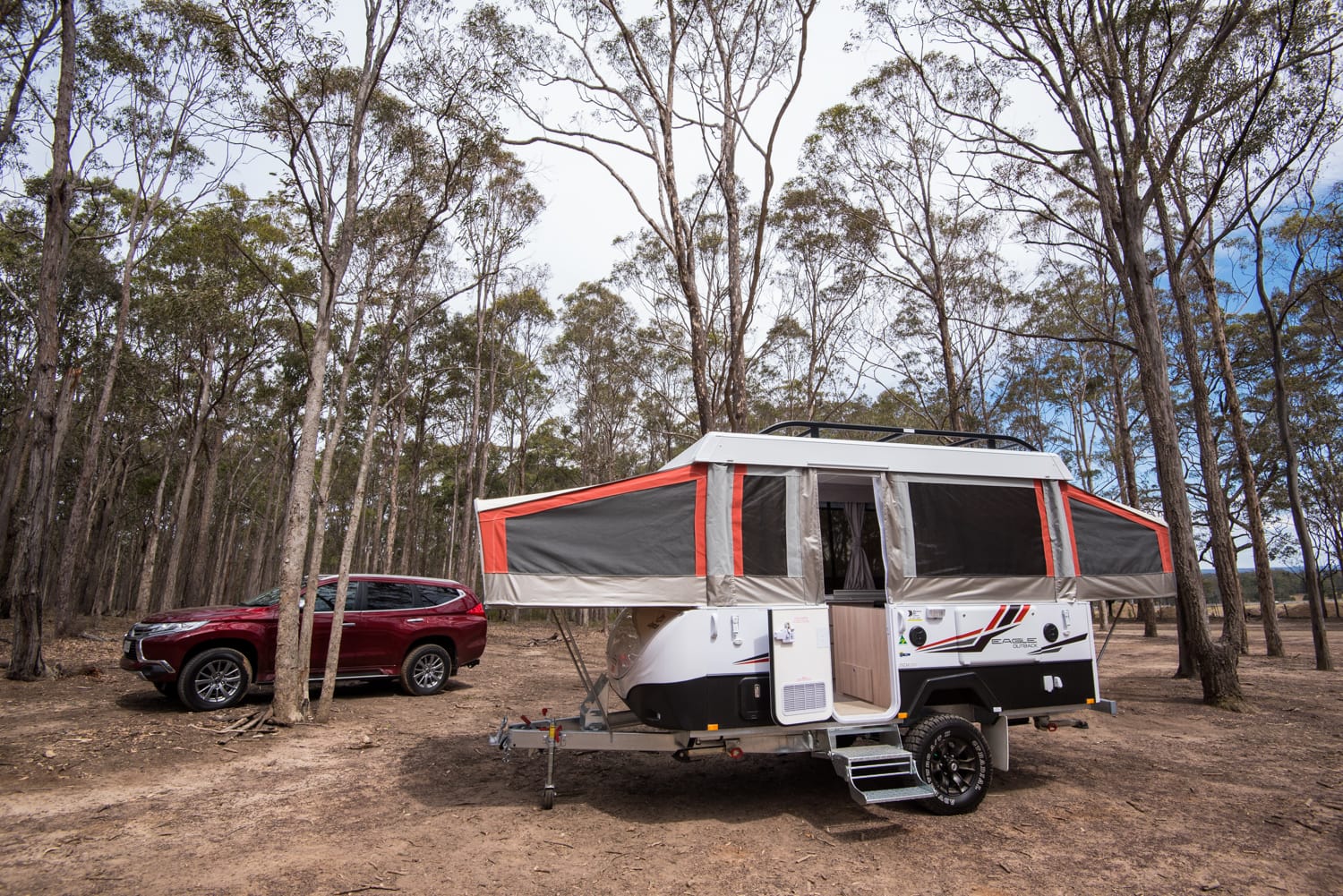
We took an Eagle Outback into the bush to check it out.

Once upon a time, not very long ago, there were tough choices to make when it came to buying a seven-seat SUV. Did you want lots of space? A hybrid? Or, for it to be affordable?
In a move that will no doubt horrify old favourites, Chery’s new Tiggo 8 Super Hybrid sets out to prove you can have all of these things at once.
Offering seven seats in an ideal upper mid-sized format, complete with a plug-in hybrid system at the price of a combustion rival, the Tiggo 8 ticks too many boxes to count.
Is it too good to be true? We went to its Australian launch to find out.
The Jayco Eagle Outback, for me, is an example of a camper-trailer getting closer to what I reckon a truly off-road-capable Jayco camper will be like.
There's nothing in Jayco's current line-up that offers comfort and full functionality and is also capable of tackling decent off-roading, so we're looking forward to testing Jayco's first line-up of dedicated off-road campers, including the JTrak Outback and Outback X.
A bargain price, clever hybrid system, and a spacious interior with useful third row is a rare and potent combination which should continue to catapult Chery into a successful future.
Sure, the dull driving dynamics, sometimes befuddling software, and over reliance on touchscreens could and should be addressed, but at this price and with these ownership terms, the Tiggo 8 Super Hybrid is a tough proposition to argue with.
Note: CarsGuide attended this event as a guest of the manufacturer, with accommodation and meals provided.
These Jayco camper-trailers have a familiar touring-friendly floor-plan – check out the accompanying photos for proof of that – and most adhere to a similar approach to interior functionality – neat and simple – and that’s well suited to those who venture off the blacktop and hit the dirt.
Interior height is 2070mm, standard for campers of this type, so there’s plenty of stretch space for those of us not gifted with the vertical inches of Collingwood’s Mason Cox. Bench height, also standard for a camper-trailer, remains just lower than an average bloke’s hip so stooping to work in the kitchen is still an issue, but that’s part and parcel of the lifestyle, so stop whinging and get used to it.
Looking from the door, to the left is the front bed and club lounge; along the wall is the kitchen area (replete with four-burner stove, Dometic 95-litre fridge*, storage drawers and pantry); and to the right is the rear bed and dinette area. (* Outback models get the 95-litre fridge; Touring models get the 90-litre fridge.)
Overhead interior lighting includes LEDs for the main area and reading lights for the beds; there’s a fan for the beds.
There are also power points and USB port.
The Tiggo 8’s cabin is enormous and has had various upgrades since the combustion car launched that make it both easier and less easy to use.
For example, the centre console redesign is more contemporary, offering pride of place to the wireless phone charging bay, offering two larger bottle holders off to one side. Some key driver functions appear on the right-hand side, including a drive mode selector dial and a handful of shortcuts for the most basic climate functions, like an auto AC button and front and rear defoggers.
This means the shifter has moved to the column on the right-hand side, with a multifunction stalk for the indicators and wipers on the left instead.
The armrest console box is an overcomplicated split opening design, but offers plenty of room inside. There are two large bottle holders and pockets in each front door, too, and there’s a large pass-through area underneath the bridge-style console which will be great for a handbag or something.
The seating position is quite adjustable, but you sit unusually high in the car, which makes it feel as though you’re peering down on the instruments.
As already mentioned, the full array of climate functions can only be controlled through the touchscreen, with no physical buttons outside of the handful on the centre console. Would it be so hard just to have a temperature and fan speed dial you don’t have to take your eyes off the road?
The software itself is typical of many Chinese cars at the moment. It looks good, but isn’t as functional or easy to use as you’d like. Some core functions are still buried in confusingly labelled sub-menus, particularly things like active safety features. It’s not the worst I’ve used (the Leapmotor C10 springs to mind), but it should be better given the massive screen is such a focal point of the cabin.
At least the Tiggo 8 doesn’t feel cheap in other areas, with generous soft-touch materials throughout the cabin. It might be fake leather and suede, but it does a good enough job of making the cabin feel plush and comfortable for longer journeys.
The second row is impressive. I had leagues of room in all dimensions behind my front seat position at 182cm tall. The generous amount of soft trims continue and the seat bases are comfortable enough, too. Storage comes in the form of seat-back pockets and large bottle holders in each door.
Maybe the most impressive feature is the third row. While I felt squashed into the rear row of the Mitsubishi Outlander, the Tiggo 8 offers just enough space for an adult to travel in some form of comfort. Access isn’t the easiest, but there’s so much space in the second row the the seat can slide forward to allow sufficient room for my legs. My head touches the roof, however.
There’s not much in the way of amenities back there, with a bottle holder and storage tray for third-row occupants, as well as a 12-volt outlet in the boot.
The boot itself seems large enough, although at the time of writing there was no official boot figure. For context, the combustion version offers 479 litres with the third row down, or 117 litres with it up, and this plug-in doesn’t seem significantly different to my eye.
Unfortunately though, the placement of the battery and DC inverter under the boot floor leaves no room for a spare. There’s only an inflator kit.
This single-axle camper – at 5060mm long (including drawbar), 1910mm high, 2240mm wide, and with a 1270kg tare weight – towed smoothly behind the Mitsubishi Pajero Sport we used on this review.
It sat snug and steady on the towball (with a 150kg download) during open-road driving, as well as during short sections of slightly bumpy gravel track and undulating dirt road.
The Eagle Outback has a hot dip galvanised Endurance Chassis riding on Jayco’s own JTech coil-spring suspension set-up.
Please note: Jayco’s Outback models are designed and engineered for, at worst, dirt roads and gravel roads, not 4WD tracks. Do not think that because these campers have been branded ‘Outback’ that they are actually able to tackle hard-core off-roading.
The Tiggo 8 leans into the traits on display in the smaller Tiggo 7. This means a too-high seating position trading driver ergonomics for visibility, a vague steering tune defined far too much by software, and an overly soft ride quality.
There are various trade-offs here, but it’s about the opposite of a driver’s car. The steering lends hardly any feel to what’s going on at the wheels, and the floaty ride conspires with the tall seat base to feel a bit disconcerting when cornering at high speed.
However, the positives include ease of use and relative comfort. The steering is light enough to make the Tiggo 8 pretty manoeuvrable at low speeds, and the soft ride has the Tiggo 8 floating over road imperfections with relative ease.
It’s also quick, with the electric motor providing urgent acceleration, but this is somehow not very engaging or fun regardless. Plus, slamming the accelerator down, particularly in Sport mode, will overwhelm the front tyres.
This car maintains over 20 per cent of its total battery capacity in reserve, in order to have a large buffer to draw from in hybrid mode to facilitate the smooth electric driving, but this also allows more room to store regenerated energy from idle time or braking compared to a plugless hybrid.
It seems to drive as an EV most of the time, although it lacks a true one-pedal driving mode despite having three levels of regenerative braking.
The cabin is impressively quiet, particularly at lower speeds. It’s genuinely hard to tell when the combustion engine is on to assist the electric driving functions, and the standard acoustic glass keeps most of the nasty ambient noise out. However, at speeds above 80km/h, road noise eventually finds its way into the cabin.
There are many rivals that provide an overall better balance of driving dynamics and handling with comfort, but this Tiggo 8 shoots for a more comfort-oriented family buyer who just wants a quiet and fuel-efficient SUV.