What's the difference?
In a camper-trailer market seemingly in danger of being swamped by cheap products of dubious build quality, it is refreshing to see a local mob, Australia’s Cub Campers, persisting with well-built and highly functional camper-trailers packed with standard features and with plenty of optional extras.
The company's 2.2m rear-fold* line-up includes the Weekender, Explorer and Brumby; its 3.6m line-up includes the Traveller, Escape and Longreach. (* When the trailer is static, its roof can be unfolded to the rear to become the hard floor of the camper’s entry-way. Check out the accompanying photos to better understand the process.)
Our test Brumby was a standard model (from $29,490) with an Adventure Pack ($1300) and draught skirt ($225), giving it a $31,015 price-tag.
People with camper-trailers are increasingly looking to push their travel boundaries and so they head off the bitumen, onto dirt roads and go bush.
But on-road camper-trailers are not suited to cope with the extra stresses that dirt-road or gravel-track driving bring, which is why campers better equipped for light-duty bush driving, such as Jayco’s Outback versions of its models, are finding favor with buyers.
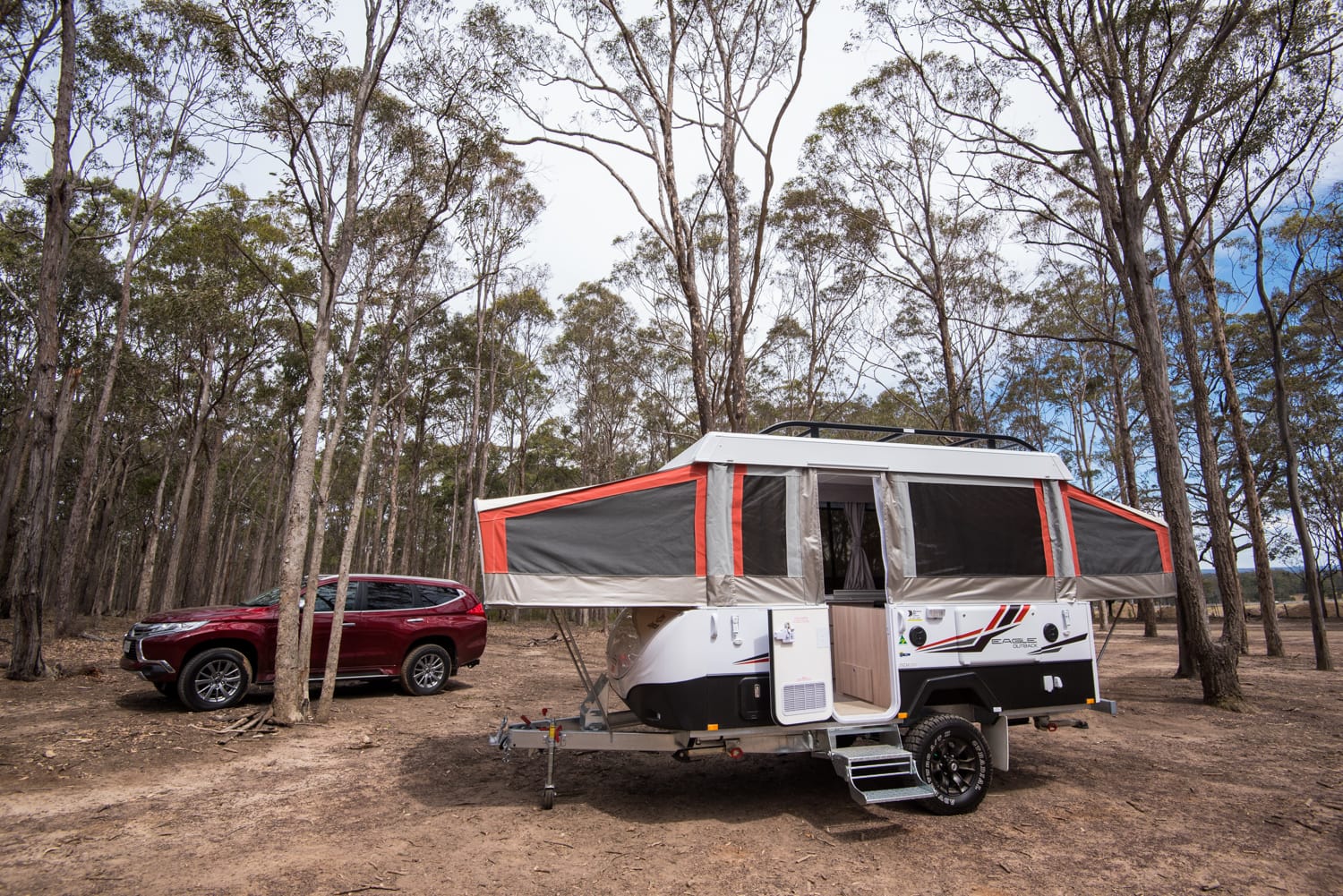
We took an Eagle Outback into the bush to check it out.

The Brumby is a fine example of top-notch design and manufacturing at a reasonable price.
It looks great, tows well, is very easy to set up and take down and does everything Cub Campers claims it’ll do – with no fuss.
Any issues in this camper are really only a matter of nit-picking and can easily be rectified with Cub options or adjustments.
The attention to detail is superb and, as a built-for-purpose camper, the Brumby certainly hits the mark.
The Jayco Eagle Outback, for me, is an example of a camper-trailer getting closer to what I reckon a truly off-road-capable Jayco camper will be like.
There's nothing in Jayco's current line-up that offers comfort and full functionality and is also capable of tackling decent off-roading, so we're looking forward to testing Jayco's first line-up of dedicated off-road campers, including the JTrak Outback and Outback X.
It’s big and airy inside and really is a basic but functional space.
The Brumby’s kitchen, fridge, pantry and more storage spaces are accessed via the camper’s exterior so there’s not a lot going on inside this camper, but the storage ideas and solutions in here – including under and alongside the bed – are well suited to camping life.
The floor of the entry-way could be used alternately as a children’s bedroom and eating area, if you don’t bother setting up your awning for dining purposes.
The main bedroom is open and easy to access from the entry-way, and the bed has storage space underneath and along each side.
These Jayco camper-trailers have a familiar touring-friendly floor-plan – check out the accompanying photos for proof of that – and most adhere to a similar approach to interior functionality – neat and simple – and that’s well suited to those who venture off the blacktop and hit the dirt.
Interior height is 2070mm, standard for campers of this type, so there’s plenty of stretch space for those of us not gifted with the vertical inches of Collingwood’s Mason Cox. Bench height, also standard for a camper-trailer, remains just lower than an average bloke’s hip so stooping to work in the kitchen is still an issue, but that’s part and parcel of the lifestyle, so stop whinging and get used to it.
Looking from the door, to the left is the front bed and club lounge; along the wall is the kitchen area (replete with four-burner stove, Dometic 95-litre fridge*, storage drawers and pantry); and to the right is the rear bed and dinette area. (* Outback models get the 95-litre fridge; Touring models get the 90-litre fridge.)
Overhead interior lighting includes LEDs for the main area and reading lights for the beds; there’s a fan for the beds.
There are also power points and USB port.
At 885kg (with 139kg on the tow ball), this is a nimble and easy-to-tow trailer.
It has a galvanised steel chassis and is equipped with Cub Campers' own independent coil-spring suspension set-up, which helps the Brumby ride through undulating terrain with supreme ease, maintaining composure all the way.
Its AL-KO 50mm off-road ball hitch, which affords a greater range of motion for the coupling – up and down, and side to side – than a standard one does, gives the Brumby an extra level of flexibility and manoeuvrability on rough tracks.
Another boost to its ease of towing is the fact that, due to the Brumby's compact size, the driver is able to constantly monitor the trailer’s position as you can see over it, along its sides, and behind it, with no need for towing mirrors.
The Brumby rides on 17-inch six-stud alloy wheels, shod with Goodyear Wrangler Duratrac tyres.
It has two rated recovery points (2400kg) at the rear, which are a bonus for those who tackle decent off-roading.
This single-axle camper – at 5060mm long (including drawbar), 1910mm high, 2240mm wide, and with a 1270kg tare weight – towed smoothly behind the Mitsubishi Pajero Sport we used on this review.
It sat snug and steady on the towball (with a 150kg download) during open-road driving, as well as during short sections of slightly bumpy gravel track and undulating dirt road.
The Eagle Outback has a hot dip galvanised Endurance Chassis riding on Jayco’s own JTech coil-spring suspension set-up.
Please note: Jayco’s Outback models are designed and engineered for, at worst, dirt roads and gravel roads, not 4WD tracks. Do not think that because these campers have been branded ‘Outback’ that they are actually able to tackle hard-core off-roading.