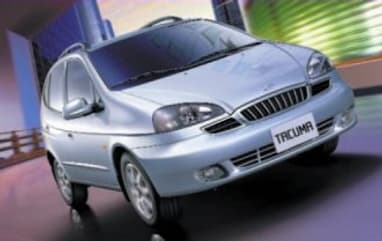
Daewoo Problems

Are you having problems with your Daewoo? Let our team of motoring experts keep you up to date with all of the latest Daewoo issues & faults. We have gathered all of the most frequently asked questions and problems relating to the Daewoo in one spot to help you decide if it's a smart buy.

Used Daewoo Lanos review: 1997-2002
By Graham Smith · 22 May 2004
Image problems may have dogged the Daewoo, but that's no big drama.  Daewoo is perhaps better known for its ads featuring Kane the wonder dog than for its actual cars.  There were even some wags who suggested the use of a dog was appropriate given the rehashed Opel the Korean company was sending here in 1994.The first Daewoos were cheap enough, but based on an Opel from the early 1980s. They were a very dated design, and the build quality was generally below market expectations.The Lanos was one of the new generation of models to come from Daewoo. It was a fresh face for the company, and started the move away from the Opel-based model.By the mid-1990s Hyundai was setting the small-car pace here with its innovative "drive away, no more to pay" pricing policy.  It changed the landscape in our most competitive market segment, making it tough for everyone trying to succeed in the segment.  Rather than compete with Hyundai's offer, Daewoo went a step further with free servicing for the entire warranty period.While Daewoo dealers appreciated the extra showroom traffic, they didn't necessarily welcome the extra traffic it created through their service departments.  Daewoo customers, it seems, took the offer of free care literally and headed to their dealer to have such minor things as failed light globes and punctured tyres repaired or replaced.The Lanos was launched in this era of free care, so sales were brisk.  It was an attractive small car with smooth lines, and was available in a choice of four-door sedan, or three or five-door hatch.Power was provided by one of two single overhead-camshaft four-cylinder engines, depending on the model.  A five-speed manual transmission was standard, and a four-speed auto was available.Power steering was standard on all models, except initially on the SE three-door hatch.  Air-conditioning became standard across all models in 1998, which also saw the addition of the LE sedan and five-door hatch limited-edition models based on the SE, but with power front windows, CD player, rear spoiler (hatch) and central locking (sedan).The Sport arrived in 1999. This was a three-door hatch based on the SX with the more powerful 1.6-litre engine, plus a sporty body kit, tacho, upgraded sound, and power antenna.Though dealers weren't exactly enamoured with the free care deal, it meant cars such as the Lanos were better serviced than they might have been had owners had to pay for work.The free care cover has expired for most cars now, and the earliest examples have clocked up about 100,000km. Anyone taking one on is gambling on their continued reliability when they will have to pay for servicing and any repairs that might be needed.Mechanically the Lanos stands up quite well. The engine is robust and doesn't appear to give much trouble in service.  The transmissions also appear quite reliable and give little trouble, but the Lanos can be let down by the little things.The electrics appear to have been put together on the cheap, and the chances of problems increase with time and mileage.  Interior trim parts are another weakness. The cheap plastic bits break fairly regularly.Barbara Barker probably would have bought a Hyundai Excel had it been available when she was shopping for a small hatch in 2001, but she didn't like the look of the Accent that had replaced the Excel.She liked the look and feel of the Lanos, and the free care offer, and bought that instead. It's now done 95,000km and the warranty has run out, so she's in the market for a larger hatch.She says the Lanos has provided good performance, is economical, and has been reliable. The exhaust has been replaced, as have the brakes, and the idle stepper motor had to be replaced at the 90,000km service.Apart from dodgy electrics and average build quality they're generally pretty robust. Trade is reluctant to handle them, but low resale value makes them a cheap buy at the right price.Attractive stylingWell-equipped with lots of standard featuresZippy performanceReliable mechanicsJury still out on longevityDodgyelectricsAverage build quality
Read the article
Japanese option the best
Answered by Carsguide.com.au · 15 May 2003

Reliability and resale should be the key factors in your decision, given you're doing about 30,000km a year. That's considerably more than the average, and in three years you'd be clocking up close to 100,000km. With that in mind I suggest you go for a Japanese brand with a reputation for quality and reliability. That way you are more likely to have a trouble-free run and have a car that will be highly valued on the used-car market when you come to sell it. The Lanos and Accent are both built in Korea by companies whose credo was cheap, cheap, cheap. While the reliability of their products wasn't necessarily poor, their cars weren't built as well as their more expensive Japanese-made rivals. The Korean makes don't hold their values as well as the cars from Toyota, Mazda, Honda and Nissan. I'd consider a Nissan Pulsar, a Mazda 121, Honda Civic or Toyota Corolla, all of which are good, robust cars with good resale potential.

Electric shocker
Answered by Carsguide.com.au · 08 Apr 2004

I HAVE no information to suggest a widespread problem with the Espero, though I can say Daewoo seems to have caught the British bug for building cars with dodgy electrics. They have a bad reputation for their electrical systems, which appear on the surface to be built to a budget and are thus unreliable. I would persist and return it to a Daewoo dealer until the problem is traced and fixed. Make sure they check all wiring loom connections. Daewoo connectors are deplorable -- make sure there are no breaks in wires and ensure the wiring isn't rubbing on a panel where you can't see it. I have seen cars where complete wiring harnesses have been replaced, only to find the problem was a damaged pin in a connector.

Sweet musso music
Answered by Graham Smith · 08 Jul 2005

THE Musso is really a SsangYong, which was well received when it was launched through Mercedes-Benz dealerships in 1996. In those times there was a link between Mercedes and SsangYong and the Musso had a Mercedes-Benz six-cylinder petrol engine and transmissions. It was a successful marriage, but when the Korean car industry went into meltdown SsangYong was handed to Daewoo. The Musso was pretty much unchanged, but the Daewoo badge is a downer for resale. Don't worry. There's nothing wrong with your car. In recent times SsangYong has become independent again and the Musso is back, this time as a dual-cab ute. The replacement for your Musso wagon is the SsangYong Rexton, which is a decent four-wheel-drive wagon.

Daewoo woe
Answered by CarsGuide team · 18 Aug 2005

THE whistling that goes away when you depress the clutch may be from the clutch throw-out bearing. The engine warning light is much more difficult to diagnose. Daewoos were prone to a range of electrical problems that could account for the odd behaviour of the warning light, but it's best to take the car to a dealer and have it checked.

Daewoo woes
Answered by Carsguide.com.au · 20 May 2004

IT COULD be a design fault, but failures such as this usually are caused by a vibration that results in a fatigue failure of the component. The first failure occurred after five years, the second after only a few months, which suggests something other than a basic design flaw is the root of the problem. Have the compressor checked to make sure it's working the way it's meant to, check the compressor mounts for looseness or cracking, and the belt for correct tension.

We disagree
Answered by Graham Smith · 21 Jul 2005

HOLDEN has a vested interest in keeping you and other Daewoo owners happy because it will soon be selling a range of small cars built by Daewoo, but badged as Holdens. Expect models like the Barina to be imported from Korea in the future. Clearly, the dealers you have dealt with have treated you poorly, and I would suggest you take it up with Holden through the company's Customer Assistance Service (ph: 1800 033 349).

Daewoo dilemma
Answered by Graham Smith · 18 Feb 2005

YOU are caught in a difficult situation not of your making. Daewoo has announced it is pulling out of Australia and that will make it hard when it comes to resolving problems. In the meantime, Holden is saying its dealers are taking responsibility for service and problem resolution. I'm sure that it will still be difficult to resolve problems like yours. I would suggest you persist in getting a satisfactory answer to your concerns, first with your dealer, then with Holden if you aren't satisfied. Phone Holden's customer assistance number, which you'll find in the telephone directory.

Air mechanics
Answered by Carsguide.com.au · 07 Mar 2003

There are a number of possible explanations, and all are linked to the airconditioning installation. Early Daewoos came fitted with much of the hardware needed for airconditioning and only needed some equipment such as the compressor and condenser and some hoses to complete the installation. Part of the package was an idle-stepper motor which is used to stabilise the idle when the airconditioning system is turned on. If that's not fitted, or not operating correctly, the idle will probably be too low and unstable, and the engine could stall as a result. Difficulties restarting could be due to too much load being applied to the engine by the airconditioning system. Check the installation to make sure the electric fan is operating correctly. If it's not, it could result in too much pressure building up in the system, which in turn can increase the drain on the electrical system and make it more difficult to crank the engine over when starting. While these are some suggestions, I would strongly recommend that you take the car to an airconditioning expert and have the system checked.

Pleasure turns to pain
Answered by Carsguide.com.au · 24 Apr 2003

That's quite a run of misfortune and your message is fair. As I wrote in my review of the Daewoo 1.5i, buying an early Daewoo, whether new or secondhand, is a gamble. They were poorly built and the ancillaries were unreliable and of poor quality. But the Holden-built four-cylinder engine was generally reliable, despite your bad experience. Remember, you get what you pay for. The cheap and cheerful Daewoo was designed to be thrown away relatively quickly.

Disclaimer: You acknowledge and agree that all answers are provided as a general guide only and should not be relied upon as bespoke advice. Carsguide is not liable for the accuracy of any information provided in the answers.
Have a new question for the CarsGuide team?
More than 9,000 questions asked and answered.
Complete guide to Daewoo
Complete guide to Daewoo CarsGuide Logo
Reviews, price, specs and more