What's the difference?
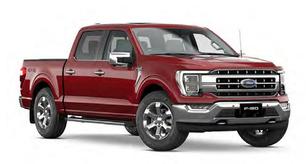
US utes are becoming increasingly popular in Australia. And the Ford F-150 Lariat long wheelbase – the top dog in the F-150 line-up – is the latest arrival in America’s full-size pick-up invasion of Australia.
If you’re considering a US ute like the Ram, Chevrolet Silverado or even the upcoming Toyota Tundra, then the F-150 seems, on paper at least, well-engineered, well-equipped and purpose-built for towing and touring.
Americans love the F-150, so why shouldn’t we? But is it any good off-road?
Read on.
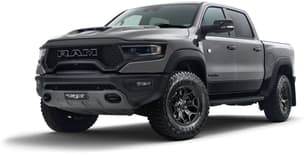
RAM Trucks Australia claims the RAM 1500 TRX is the quickest, fastest (those are drag racing terms) and most powerful pick-up truck in the world. Built to rule the road and dominate the desert. The ultimate on-road/off-road big boy’s toy.
With launch control and more than 700 supercharged V8 horses harnessed beneath the bonnet, RAM claims this 3.0-tonne-plus behemoth can accelerate from 0-100km/h in an implausible 4.5 seconds, scorch the standing quarter-mile (400m) in 12.9 seconds and hit a top speed of 190km/h.
No wonder they call it the TRX, named after the Tyrannosaurus rex (aka T-REX) that was the ‘apex predator’ in the dinosaur era. As depicted in Steven Spielberg’s Jurassic Park movies, nothing else stood a chance, not even the Raptor (yeah, we get it).
So, this is no ordinary RAM 1500. It’s the premium-priced halo model of the range and not what you’d call a volume-selling truck.
Even so, we recently spent a week behind its leather-wrapped, flat-bottom, paddle-shifter-equipped steering wheel to find out how it might perform in the dual roles of tradie’s weekday workhorse and family getaway machine.
The Ford F-150 Lariat LWB is a big comfortable, purpose-built work and adventure machine – but it’s better suited to load-lugging, towing and touring, than it is to hard-core 4WDing.
Despite that – and its less-than-ideal payload – there’s a lot to like about the Lariat, especially its on-road performance, 4.5 tonne towing capacity and factory-backed warranty.
If you’re serious about buying a US ute the F-150 should be in your sights.
Applying our usual measures of workhorse practicality and efficiency to the TRX is difficult. It's an extreme machine designed for those who want the ultimate in luxury, performance and pose value in a pick-up truck, regardless of how large, thirsty and costly it may be. And on that scorecard, it has no equal.
The long-wheelbase F-150 Lariat is 6184mm long (with a 3994mm wheelbase), 2030mm wide, 1995mm high and has a kerb weight of 2555kg.
With a stretched wheelbase and chunkified body everywhere you look, this F-150 looks and feels massive but, really, this is not a whole lot bigger than a Ranger, 300 Series LandCruiser, or a new-gen Patrol. It does, however, have an undeniably in-your-face presence.
For reference, the Ranger is 5370mm long, 1920mm wide, and 1880mm high; the LC300 (Sahara ZX) is 5015mm long, 1980mm wide, and 1950mm high; and the Patrol is 5165mm long (all variants), 1995mm wide (all variants) and 1940mm/1955mm high.
The Lariat’s 20-inch chrome-like alloys, shod with Pirelli Scorpion ATR all-terrain light truck tyres (275/60R20) cap off this US pick-up’s bulky style.
A lot of its notable design features are thoroughly functional rather than noteworthy because of their looks, so rather than include them in this section you'll find them in ‘Practicality’ (below).
The TRX rides on an expansive 3686mm wheelbase, is just under 6.0 metres in length, a snip under 2.5 metres in width and stands just over 2.0 metres tall, with a bus-sized turning circle of almost 15 metres.
Off-road credentials include 295mm ground clearance, 812mm wading depth, 30.2 degrees approach angle, 21.9 degrees ramp breakover angle and 23.5 degrees departure angle.
The robust body-on-ladder-frame design features twin A-arm/coil spring front suspension and a five-link/coil-spring live rear axle, all damped by high performance Bilstein remote-reservoir shock absorbers. There’s also electric power-steering and, as you would expect, enormous disc brakes.
It looks oh-so-tough from any angle, from its wide-track stance to its pumped-out guards and wheel arch flares to its conspicuous engine scoops and vents that hint at the force-fed Hemi V8 that lurks within.
The standard of finish, given its extensive local RHD re-manufacturing, is outstanding.
The trim stitching is arrow-straight and the contrasting visual mix of carbon fibre, brushed metal, satin chrome, piano black and acres of cowhide in a tasteful blend of light and dark grey tones exudes opulence.
The complex RHD dashboard module is particularly impressive in its OEM quality and attention to detail.
The front bucket seats with their multiple power adjustments offer superb comfort and support and the rear seating is of limousine standard, even for tall adults who can genuinely stretch out thanks to palatial leg, shoulder, hip and head room.
Although at its most luxurious with two rear passengers, three adults can travel comfortably in the rear on long trips, with the flat floor devoid of a transmission tunnel and access to four USB ports, a/c vents, outer seat heating/cooling and deep-tinted privacy glass.
The interior of the F-150 is cavernous, but it’s functional and comfortable with a definite premium look and feel about it all.
From the front of the cabin to the rear, this space is geared towards being practical.
For one, the multi-media system is easy to pair to your phone and operate. Just allow yourself a few minutes before you set off in the Lariat for the first time so you can get your head around how to navigate your way through the system.
There’s ample storage space – including a deep centre console*, cupholders and bottle-holders for everyone, as well as the usual glove box (times two) and seat pockets for rear-seat passengers.
*In a stroke of Ford genius, the auto shifter power-folds forward into a recess, giving you room to unfold the lid of the centre console and turn that large surface into a picnic table or work desk.
Space is further maximised in the rear 60/40-split seat as it has a fold-out storage area underneath it, or the seat itself, if not in use, can be stowed away to free up even more room in the cabin.
The stretched Lariat’s tub is 2005mm long and 1656mm wide with 1285mm between the wheel-arches – so it will fit an Aussie pallet, or a quad bike, camping gear etc.
This load space also has a 12-volt outlet, night lights, a tub camera (which I couldn’t get to work), a durable-looking spray-in tub liner, as well as fixed tie-down points at each corner and four sidewall-mounted tie-down points (two on each inner wall).
Remember I mentioned some design features that err on the side of practical rather than pretty? I’m talking about this F-150’s chunky side-steps, which serve an obvious practical function, and its remote-controlled and power-assisted tailgate (a nifty feature), its fold-out step (a real handy addition) and the accompanying slide-out guide pole for something secure to hold onto as you climb in and out of the tub – well, that’s what we used it for anyway, whether that’s its intended purpose or not.
Bonus usage points for the raised ruler markings on the inner wall of the tailgate and the two G-clamp fitting positions at each side of the tailgate’s top edge.
The Lariat even has a keyless entry system with a keypad on the exterior of the vehicle (front passenger door). Punch in your permanent access code and bingo, you're in!
With its 3057kg kerb weight (the optional sunroof adds 24kg) and 3800kg GVM, our test vehicle has a relatively small 743kg payload rating.
It’s also rated to tow up to 3500kg of braked trailer, but to avoid exceeding its 6878kg GCM (or how much it can legally carry and tow at the same time) the TRX’s maximum payload would need to be reduced by 422kg to legally tow that weight.
And that would leave only 321kg of payload capacity, which could easily be used up by a crew of four adults without luggage. A more practical solution would be to simply lower the trailer weight by that same 422kg to 3078kg (which is still a large trailer) and keep the full payload.
The big load tub, with its tough spray-in liner, measures 1711mm long, 1687mm wide and 543mm deep. It also spans 1295mm between the wheel housings, so it would comfortably take one standard Aussie pallet or two Euro pallets.
There are four load-anchorage points at floor level and sliding-track adjustable load anchorage at the top level, so all load heights are catered for.
The big tailgate features an easy-drop/easy-raise function and there’s ample load tub lighting from the rear of the cab and inner sidewalls.
A multitude of cabin storage options starts with the front doors which have deep lower bins with large-bottle/small-bottle/cupholders, plus smaller bins at mid-height. There’s also an overhead glasses holder and upper and lower glove boxes.
The huge centre console has two small-bottle/cupholders in the centre and behind them is a cavernous box with a classy padded and suede-covered lid, plus two bottle holders at the back.
Outer rear passengers get two-tiered bins and a large-bottle holder in each door, plus pockets on each front seat backrest.
The rear seat's centre backrest can be folded down to reveal another sizeable console, with two small-bottle/cupholders and a padded lid that accesses a shallow bin, ideal for storing slim devices.
The rear floor also has access to large underfloor storage boxes on each side and the 60/40-split seat bases can be raised to reveal more storage space beneath.
They can also be stored vertically if more internal carry space is required. You won't run out of places to put stuff.
There are two F-150 spec levels in Australia – the XLT and the Lariat – and both are available as a short- or long-wheelbase.
Our test vehicle is the Lariat long wheelbase. It’s a five-seat dual-cab ute with a price-tag of $140,945 (excluding on-road costs). The XLT is about $33,000 cheaper.
Standard features include a 12.0-inch touchscreen-based multimedia system (with wireless Apple CarPlay and Android Auto), heated and ventilated leather-accented seats, a two-panel power moonroof, 20-inch chrome-like alloy wheels, front and rear parking sensors, a cabin-length power-operated sunroof, a remote-controlled and power-assisted tailgate and more.
Exterior paint choices include 'Oxford White' (at no extra cost) or 'Agate Black', 'Iconic Silver', 'Rapid Red' (on our test vehicle), 'Antimatter Blue' or 'Carbonised Grey' – each costing $700.
Our 'Flame Red' test vehicle comes with the TRX's exclusive 6.2-litre supercharged Hemi V8, plus 'TorqueFlite' eight-speed torque converter automatic and full-time 4WD for the princely sum of $209,950, plus on-road costs.
Our example is fitted with the only option, a full-length panoramic sunroof, which adds $10,000 to the price.
So, we’re talking $219K, which is a lot of coin for an American pick-up truck. However, if you look beyond its high-performance capabilities, it’s largely hand-built at RAM Trucks Australia’s right-hand drive re-manufacturing facility in Melbourne, which is the only RAM-authorised RHD manufacturing facility in the world.
It’s also packed with features, luxury and tech. There’s 18-inch black-finish alloy wheels and chunky 325/65R18 Goodyear Wrangler all-terrain tyres plus a full-size alloy spare, 3500kg towing kit with trailer brake controller, recovery hooks front and rear, underbody protection, 360-degree and reversing cameras and more.
Inside you get luxurious leather and suede upholstery, carbon- fibre trim elements, paddle-shifters, huge 12-inch multimedia touchscreen with multiple connectivity, 7.0-inch colour driver’s information display, 19-speaker Harman Kardon audio, wireless phone charging, heated door mirrors, heated steering wheel, heated/cooled front and outer rear seating, nine USB ports and on it goes. What you might call fully-loaded.
The F-150 has a 3.5-litre twin-turbo petrol V6 producing 298kW at 6000rpm and 678Nm at 3100rpm, and that’s matched to a 10-speed automatic transmission.
This is an impressive set-up – the long wheelbase F-150 is punchy off the mark, smooth and refined at highway speeds – it just trucks along – and overall it offers a comfortable and controlled driving experience.
This top-spec F-150 – the Lariat – also has full-time 4WD and an electronic rear diff lock.
Its selectable driving modes include 'Sport', 'Eco', 'Tow/Haul', 'Normal', 'Slippery', 'Deep Snow/Sand' and 'Mud Ruts'.
The 6.2-litre Hemi V8 is armed with an 11psi twin-screw supercharger. Together with the bonnet’s unique air-induction system, it produces an eye-watering 523kW (702bhp) at 6100rpm and 882Nm (650ft/lbs) of torque at 4800rpm.
The eight-speed torque converter automatic offers a choice of sequential manual shifting, and overdrive on the top two ratios ensures low engine rpm to optimise fuel efficiency at highway speeds.
There's also launch control (!) plus eight drive modes comprising 'Snow', 'Tow', 'Sport', 'Baja', 'Mud/Sand', 'Rock', 'Custom' and 'Auto', linked to performance pages on the centre touchscreen. The Borg Warner full-time AWD system offers high and low range and there’s a locking rear diff.
The Ford F-150 Lariat LWB has an official fuel consumption figure of 12.5L/100km (on a combined, urban/extra-urban, cycle).
I recorded 14.8L/100km on this test which included a lot of high- and low-range 4WDing although the F-150 was never working hard.
This F-150 has a 136L fuel tank, so, going by my on-test fuel-consumption figure, you could reasonably expect a driving range of about 920km from a full tank.
If you calculate driving range using the official fuel-consumption figure that number extends to 1088km from a full tank.
Because heavy vehicles are not required to report their fuel consumption or CO2 emissions to comply with the Australian Design Rules, RAM does not list official figures for the TRX.
Even so, our TRX’s dash display was claiming average combined of 20.6L/100km at the conclusion of our 315km of testing, which included some ‘spirited’ driving (well, someone had to do it) and a mix of city, suburban and highway work of which about a third was hauling its maximum payload.
The TRX’s figure was close to our own, calculated from fuel bowser and tripmeter readings, of 21.6L/100km.
So, based on our figures, you could expect a realistic driving range of around 580km from its enormous 125-litre tank. And this beast drinks premium unleaded.
F-150s are imported to Australia from the USA as left-hand-drive vehicles and reengineered to right-hand-drive by Melbourne-based RMA Automotive, at the company’s production facility.
The utes undergo an exhaustive transformation including changes to steering, driver displays, air con, as well as software upgrades, to mention a few, all aimed at making them capable of excelling in Aussie conditions.
And RMA Automotive has done an impressive job.
The F-150 is, by its very nature, a big vehicle with a steel ladder-frame chassis and a lengthy wheelbase, but it suits Aussie conditions, especially with Aussie-tuned steering, great on-road ride and handling and that 4500kg towing capability built into it.
It's well-controlled with a solid, planted feel on sealed surfaces, the steering has a nice weight to it in all conditions, acceleration is smooth (and punchy when needed) and the 10-speed auto offers clever management of this big vehicle.
It’s also very comfortable and quiet in the cabin. You can just barely register the low-level rumble of the twin-turbo V6 as you truck along stretches of highway and rural backroads.
All in all, on-road this is an almost perfect open-road touring vehicle. The bonus is, as a Lariat driver, you have access to a whole suite of driver-assist tech which specifically includes stuff geared towards making the task of towing safer, more controlled and, as a result, more enjoyable than it otherwise may be.
However, when you get this big ute off road, you quickly discover it has limitations. Those limitations don’t come close to ruining the F-150’s potential as an adventure machine, but this is a substantial vehicle so it has to be driven with real consideration, real care, and you have to know the off-road parameters in which this ute works best.
If you drive anything more severe than light-to-medium-duty off-roading you're risking damage to this ute’s side steps or underbody.
The F-150’s size is not a factor when the tracks are nice and wide, but when the tracks become narrower, more treed-in, it becomes more difficult to navigate through those routes.
The Lariat’s suspension – IFS (twin wishbone) with coil springs at the front and live axle on leaf springs at the rear – is well set up to soak up lumps and bumps on sealed surfaces and even on gravel tracks, but it is less capable of doing the same job during low-range 4WDing.
It becomes very bouncy, when you’d be excused for expecting that longer wheelbase would offer a bit more stability and control through shallow to moderate ruts, but it really is a wild ride.
Beyond that, though, visibility is great, the driving position is commanding, steering at low speeds is well-weighted and precise and throttle response is impressive.
While there’s little to nit-pick in terms of the four-wheel drive system onboard this ute, the traction control system is somewhat clunky.
When the terrain becomes more challenging, that off-road traction control system just seems to whirr and click and clunk away with lacklustre application – it’s not exactly smooth or seamless.
The F-150 has the kind of off-road angles you’d expect for a vehicle this large: approach angle is listed as 24 degrees, departure angle is 26.3 and the ramp-over is 19 degrees.
Ground clearance is listed as 225mm and wading depth is 600mm.
The tyres – Pirelli Scorpion ATR all-terrain light truck tyres (275/60R20) – aren’t that good for off-roading, either, even though they’re marketed as all-season tyres.
Bigger tyres and an aftermarket suspension lift would go some of the way to help sort out the F-150’s issues with less-than-ideal rubber as well as poor ground clearance and off-road angles.
For such a big ute, payload is an underwhelming 710kg; for reference, the Ram 1500 (878kg) and Chevrolet Silverado (757kg) offer more, and even mainstream dual-cab utes, such as the Ford Ranger (966kg (kerb weight)/1010kg (min kerb weight) offer better payloads.
Towing capacity is 750kg (unbraked) and a noteworthy 4500kg (braked). GVM is 3265kg, and GCM is 7765kg.
There’s the sweet smell of leather when you open the door and climb aboard. The Hemi V8 booms into life, with the big dual exhaust outlets releasing a pulsating rumble at idle which leaves no doubt about this engine’s intent.
It’s easy to find a comfortable driving position with the powered multiple seat adjustments, height/reach adjustable steering column and big left footrest, which together with the sizeable door mirrors, cameras and driver aids provide commanding visual coverage.
The TRX tends to shrink around you the more time you spend behind the wheel. Even so, there’s no escaping the fact this is a large truck that requires planning ahead for each drive in terms of accessing narrow streets, multi-storey carparks, drive-thru takeaways, automatic car washes, etc.
When you hit the throttle hard from a standing start, the acceleration of a vehicle weighing more than three tonnes seems to defy the laws of physics.
With a thunderous roar, it leaps forward with unrelenting force as four paws provide ample grip and the supercharger emits a high-pitched whine reminiscent of a destructive wind. There's some serious muscle under your right foot.
By contrast, its alter-ego is happy to cruise around sedately, with barely a big toe on the accelerator pedal given its enormous torque.
It’s also an effortless highway cruiser, requiring only 1600rpm to maintain 110km/h. Engine and wind noise are low at these speeds, with most noise coming from the tyres’ aggressive off-road tread patterns, but it’s far from intrusive.
The ride is supple and with this much sprung weight it flattens out bumps like a hot iron across a crinkled shirt.
For our GVM test we forklifted 650kg into the load tub which with driver just snuck in under the 743kg payload limit. The rear coil springs compressed about 80mm under this load but with such long travel suspension that still left ample clearance to avoid any bottoming-out on our test route.
It also scoffed at our 30 per cent gradient 2.0km-long set-climb with this load on board, easily reaching the summit in fourth gear while barely touching the accelerator pedal.
Engine-braking on the way down in a manually-selected second gear was equally competent, as we never needed to touch the brakes to stay below the 60km/h speed limit.
The F-150 does not have an ANCAP safety rating because it has not been tested.
As standard it has six airbags (driver and front passenger front and side airbags, plus side-curtain) and top-tether points for child seats/baby capsules on the three rear seat positions.
Driver-assist tech includes AEB, blind-spot monitoring, lane-keeping assist, front and rear parking sensors, tyre-pressure monitoring, a 360-degree camera view, trailer sway control, dynamic hitch assist, back-up assist, trailer light check and trailer theft alert.
Given the TRX’s size and weight, it’s not eligible to be assessed for an ANCAP star rating.
Even so, driver and front passenger are protected by multiple airbags and rear passengers share in side-curtain airbag protection.
There’s also forward collision warning with active braking, blind-spot monitoring, rear cross-traffic/trailer detection and lane departure warning, plus tyre pressure monitoring, park assist, 360-degree and reversing cameras, trailer sway control and more.
The F-150 has a five-year/unlimited km warranty and you may pick up roadside assistance for up to seven years but it's worth noting not all Ford Dealers participate in providing the latter.
Servicing is scheduled for every 12 months or 15,000km. Capped price servicing applies to the first four scheduled services and, at time of writing, was listed as $429 a pop which isn't outrageous for a vehicle of this magnitude.
Warranty of three years/100,000km (whichever occurs first) is comparatively short in the local dual cab ute market. There’s also three years/100,000km of roadside assist. Service intervals are also relatively brief at six months/10,000km, but then Toyota has been doing that for decades.